
Anthropic is now a public company. The Claude maker priced its IPO at $83 a share on November 18, above its $70 to $78 range, and sold 980 million shares to raise $81.3 billion, TechCrunch reported. That beat SpaceX's $75 billion deal from June and makes it the largest IPO on record by proceeds.
The stock started trading on Nasdaq on November 19 under the ticker ANT. According to Deadline, it opened just before noon Eastern at about $111, touched $115, then slid back and closed its first day at $97.17, up 17% from the IPO price. All of that happened on a day when the Nasdaq Composite fell 2.25%.
For Bay Area founders, operators and investors, ANT is now the public benchmark for what a frontier AI lab is worth. Below we cover the deal terms, what the prospectus shows, and the strongest arguments on both sides, so you can form your own view. As always on this blog, we lay out the debate and leave the decision to you.
Anthropic IPO terms: price, shares and who bought in
NPR reported that Anthropic itself sold more than 956 million shares, raising around $79.4 billion, while "certain stockholders" sold more than 23 million more. The original prospectus targeted 825 million shares at $70 to $78, so the company both upsized the deal and priced above the range, which usually signals heavy demand in the order book.
At $83, TechCrunch put Anthropic's value at roughly $1.5 trillion on a fully diluted basis. That compares with the $965 billion valuation from its $65 billion private round in May. TechCrunch also reported that Amazon owns nearly 15% of the company and Google almost 14%, and that a group including AMD, Broadcom, Google, Micron, Microsoft, Nvidia and TSMC Partners agreed to buy $26 billion of non-voting shares in a private placement alongside the IPO. Each of the 7 co-founders, including CEO Dario Amodei, sold nearly 3.4 million shares in the offering, about $282 million apiece, according to the S-1 figures TechCrunch cited.
Headline totals differ by outlet. Deadline counted more than $107 billion raised because it added the $26 billion placement to the offering, while NPR and TechCrunch used $81.3 billion for the IPO itself. When you see wildly different numbers in your group chat, that's usually why.
What the S-1 says about growth and losses
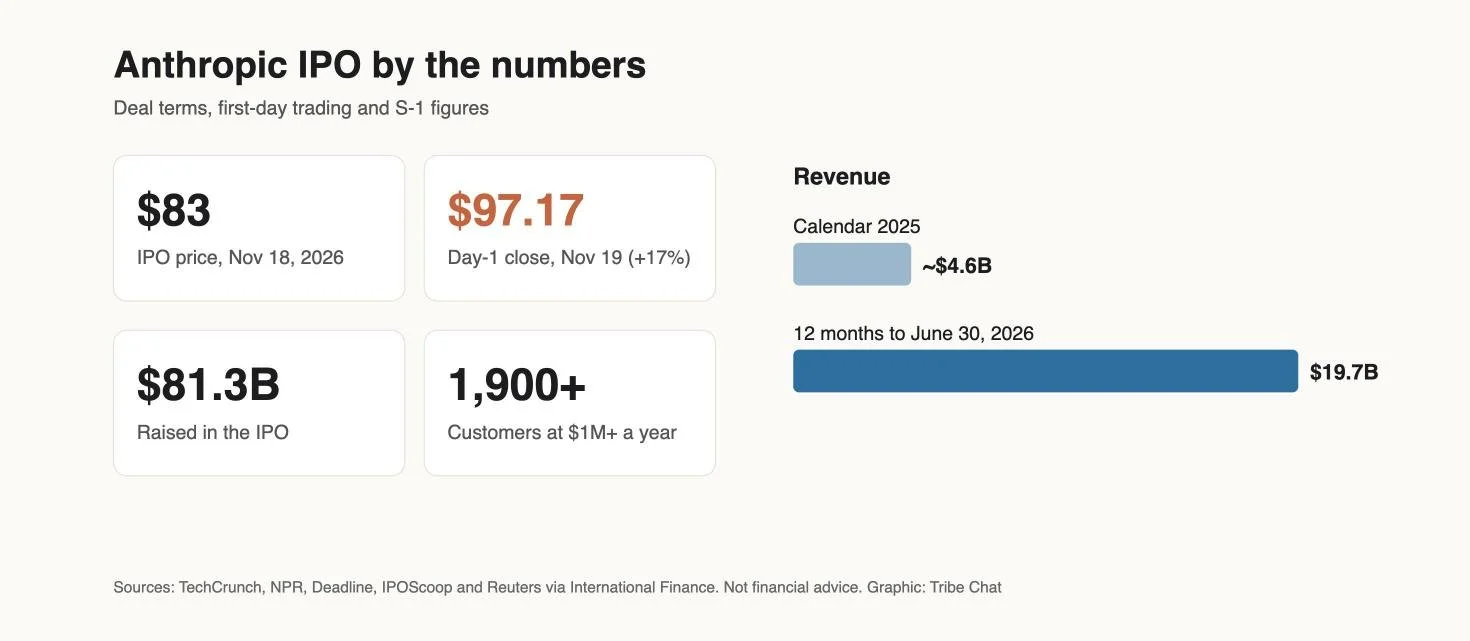
Anthropic filed its public S-1 on October 26. IPOScoop's read of the filing shows revenue of $19.7 billion for the 12 months ended June 30, 2026, with more than 11,900 customers paying $100,000 or more a year, more than 1,900 paying $1 million or more and about 250 paying $10 million or more, as of September 30. The company had raised $141.1 billion in total as of June 30, and it is still unprofitable.
A summary of Reuters' prospectus review adds the 2025 picture: revenue grew 12-fold to nearly $4.6 billion, the operating loss topped $8 billion and the net loss was $42 billion. Future cloud, compute and infrastructure commitments stand at $518 billion, and the Financial Times reported that nearly a quarter of 2025 revenue came from 2 customers.
Governance is the other big story. A single Class F share, directed by a majority of the 7 co-founders through a "Founder LLC," carries 50.1% of the voting power on key matters, and the Long-Term Benefit Trust picks 4 of the 7 directors. Anthropic stays a Delaware public benefit corporation, and its filing warns that this setup may lead to decisions that conflict with shareholders' financial interests.
The bull case for ANT stock
Supporters start with growth. Going from about $4.6 billion of revenue in calendar 2025 to $19.7 billion on a trailing basis by mid-2026 is a pace bulls see as rare at this scale, and the customer counts point to deep enterprise adoption rather than a handful of pilots. Bulls see 250 customers each paying $10 million or more as proof that big companies are building real workflows on Claude.
The second argument is backing. Amazon and Google together own close to 29%, and the chip and cloud companies that joined the $26 billion placement are the same suppliers Anthropic depends on, so their incentives line up. Bulls also point to demand at the deal itself: an upsized offering, a price above the range and a positive first day during a broad tech sell-off.
Finally, bulls argue that the safety-first brand is a commercial asset with regulated buyers like banks, insurers and health systems, who care a lot about how a model vendor handles risk.
The bear case and the risks to watch
Skeptics start with losses and commitments. A $42 billion net loss in 2025 and $518 billion in future infrastructure obligations mean Anthropic needs revenue to keep compounding for years, and a slowdown in AI spending would hit a company with those fixed costs hard. Customer concentration adds risk if a big account cuts back or builds its own models.
Bears also flag valuation and control. At roughly $1.5 trillion at the IPO price, the stock already prices in a lot of future success, and Class A holders get 1 vote per share in a structure where founders and a trust control the key decisions. The prospectus itself devotes roughly 80 of its 261 main-body pages to risk factors, including warnings about catastrophic risks from advanced AI.
Then there's supply. The SEC's investor guide on IPO lockup agreements notes that most lockups run about 180 days and that stocks can drop as locked-up shares become sellable. With thousands of employees and long-time investors holding shares, the lockup calendar is worth tracking.
What Anthropic's IPO means for Bay Area founders
For startups, a public frontier lab changes the comps. Every AI company raising a round in 2027 will be measured against ANT's revenue multiple and growth, and investors now have a liquid way to bet on the model layer. If you're building an application on top of Claude, the S-1 is also a rare look at your supplier's economics, from compute costs to customer concentration.
The deal also creates a wave of newly liquid employees in San Francisco, and that money tends to flow into angel checks and new startups. Our guide to startup tender offers for employees explains how secondary liquidity works before an IPO, and our Series A fundraising guide covers how investors are thinking about AI rounds right now. For another big AI stock debate, see our Nvidia stock analysis, and our tech IPO case studies compare ANT's first day with Facebook, Uber, Snowflake, Arm and SpaceX.
Tribe has been hosting these conversations in person too. In October we hosted Inside Native AI Companies with Gokul Rajaram in Redwood City, part of the South Bay Renaissance effort Tribe organizes to rebuild the South Bay and Peninsula startup and social scene one gathering at a time.
Debate ANT with other investors
Bull or bear, the ANT debate is better with people who read the filing. Apply to join the Investing Ideas Tribe to compare notes on earnings, valuations and the AI trade, and follow the Tribe Events calendar on Luma for founder dinners and AI talks around the Bay Area.
This post is for discussion and education only and is not financial advice. Prices and figures are as of November 19 and 20, 2026. Do your own research or talk to a licensed advisor before investing.
Header photo: Nicholas Cappello / Unsplash.
