
Every founder who hopes to go public will someday sign off on an S-1, the registration statement a company files with the SEC before an IPO. Reading other companies' filings is the cheapest way to learn what public investors will ask about your business, and Anthropic's prospectus, filed publicly on October 26 ahead of its $83-a-share IPO on November 18, is the most-read S-1 of the year.
This guide walks through the main sections of an S-1 using the SEC's own investor bulletin on IPOs as the map, with Anthropic's filing as the worked example. The goal is to help founders understand what goes into the document years before they write one.
Where to find an S-1 and which version to read
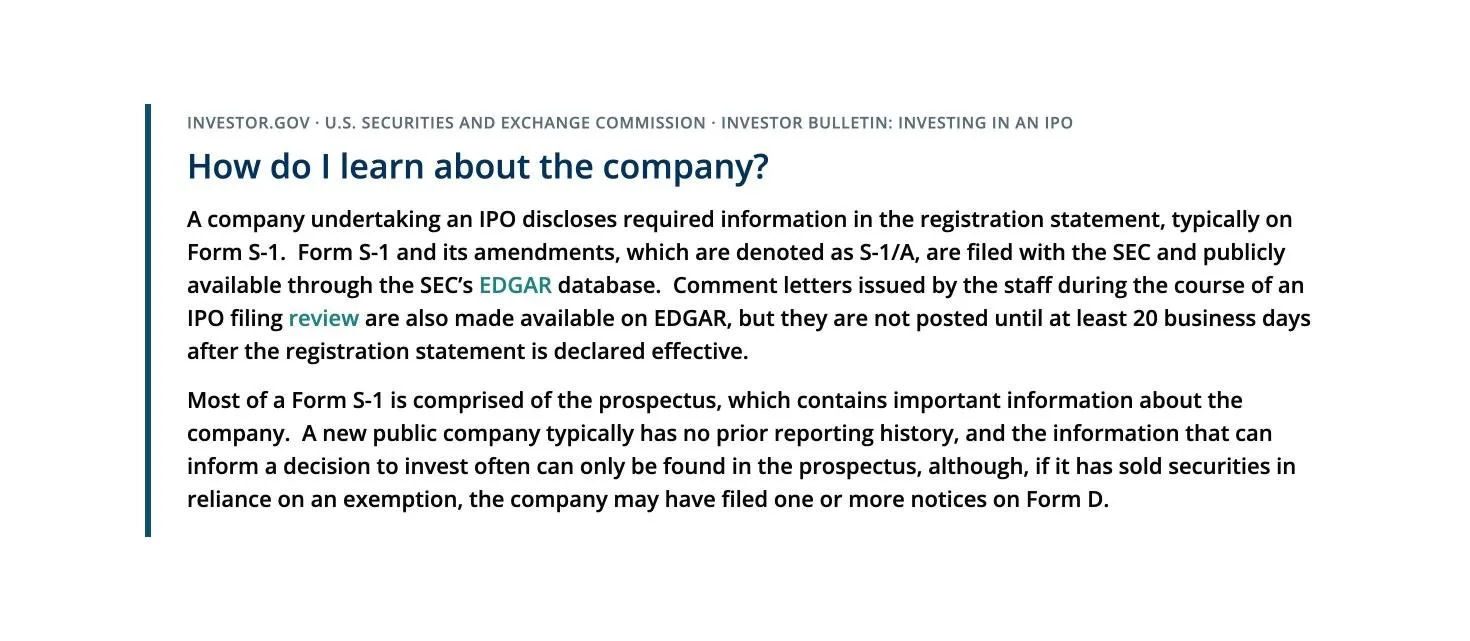
Screenshot: SEC Investor Bulletin, Investing in an IPO, on Investor.gov (captured November 20, 2026).
Every S-1 and its amendments (filed as S-1/A) live on the SEC's EDGAR database. The SEC bulletin stresses reading the most recent version, because the prospectus changes during review. After the SEC declares the registration effective, the company files a final prospectus, usually labeled 424B4, with the actual price and share count.
The SEC staff's comment letters also appear on EDGAR, but no sooner than 20 business days after the registration goes effective. For founders, those letters are gold, since they show which accounting and disclosure questions regulators pushed on.
Prospectus summary and the cover page
The summary condenses the business, strategy, use of proceeds, financials and offering terms. The cover page shows the share classes, the exchange and any shares sold by existing holders.
Anthropic's summary metrics are a good template for an AI or SaaS company. As of September 30, 2026, it reported more than 11,900 customers with $100,000 or more in trailing 12-month revenue, more than 1,900 above $1 million and about 250 above $10 million, according to IPOScoop's summary of the filing. If you sell to businesses, start tracking customer counts by revenue band now, because bankers will want 3 years of clean history.
Risk factors: longer than you expect
Risk factors list what management believes could seriously hurt the business or the stock. They're written by lawyers, but investors read them closely for clues about what keeps leadership up at night.
Anthropic's section is unusually long. According to a summary of Reuters' review of the prospectus, roughly 80 of its 261 main-body pages are risk factors, nearly double the 48 pages on the business, compared with about 38 of 277 pages for SpaceX. The filing warns that advanced AI could pose catastrophic risks and flags customer concentration, with nearly a quarter of 2025 revenue coming from 2 customers.
For a startup, the takeaway is simple. Any dependency you'd hate to see in print, like a single cloud vendor, a top customer or a key supplier, will end up in this section, so start diversifying early.
MD&A, financial statements and the numbers that matter
Management's Discussion and Analysis (MD&A) is where leadership explains in plain language why results changed. Right before the financial statements sits the auditor's opinion. The SEC bulletin notes that emerging growth companies, generally those with under $1.235 billion in revenue, can include 2 years of audited financials instead of 3.
Anthropic's numbers show why this section draws the most attention. Revenue reached $19.7 billion for the 12 months ended June 30, 2026, per IPOScoop, while the Reuters-based summary reports a 2025 net loss of $42 billion and $518 billion in future cloud and compute commitments. Expect public investors to read your MD&A the same way, looking for growth drivers, gross margin trends and how long your cash lasts.
Dilution, selling shareholders and capital stock
The Dilution section compares the IPO price with book value and with what earlier holders paid. The Principal and Selling Shareholders section shows who owns what and who is selling. TechCrunch reported, citing the S-1, that each of Anthropic's 7 co-founders sold nearly 3.4 million shares, about $282 million each at $83, and that Amazon holds nearly 15% and Google almost 14%.
The Description of Capital Stock explains voting rights. The SEC bulletin warns that dual-class structures can make it hard for public shareholders to influence the company. Anthropic goes further than most: 5 share classes, plus a single Class F share directed by its co-founders that carries 50.1% of the vote on key matters. If you want founder control after an IPO, decide early, since that structure has to be in the charter before you go public.
Shares eligible for future sale and lockups
This section shows how many shares will become sellable after the IPO, sometimes called the market overhang. The SEC's lockup guide says most lockups bar insiders from selling for 180 days and that prices can drop when they expire. Employees should read this part before planning any big purchases.
If you're earlier in the journey, our guides to filing an 83(b) election and startup tender offers cover the equity decisions that shape your cap table long before an S-1. When you're ready for the bigger plan, our IPO readiness checklist lays out the 12 months before filing, and our Anthropic IPO explainer covers ANT's first day.
Read S-1s with other founders
S-1s are long, and reading them with friends helps. Tribe organizes South Bay Renaissance to rebuild the South Bay and Peninsula startup scene in person, with founder dinners and AI deep dives from Palo Alto to San Jose, and you can join the South Bay Renaissance Tribe to find them. If you'd rather debate the stocks themselves, apply to join the Investing Ideas Tribe, and follow the Tribe Events calendar on Luma for upcoming events.
This post is for discussion and education only and is not financial or legal advice. Talk to qualified counsel and advisors before making decisions about an offering or an investment.
Header photo: Erwan Hesry / Unsplash. Screenshot: SEC Investor.gov.
