
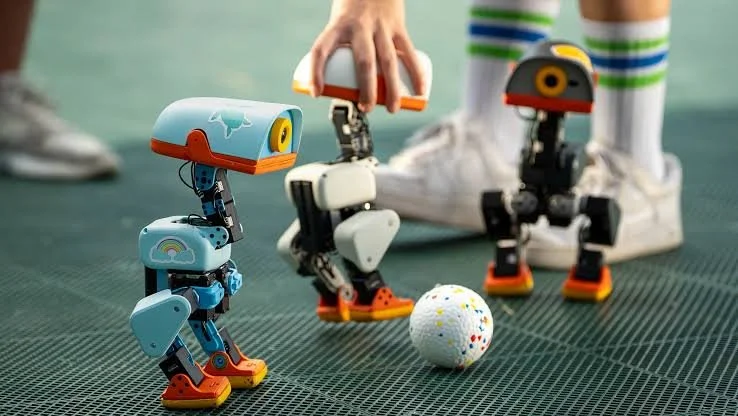
Microduck is a 25 centimeter tall, duck-shaped robot from Pollen Robotics, the Bordeaux robotics company owned by Hugging Face, and it became one of the most talked-about gadgets of the month after Nvidia CEO Jensen Huang played with a group of them on stage. It costs $399 at its introductory price, preorders are open, and first deliveries are targeted before Christmas 2026. Here's what it does, which parts are open source, and who it's best suited for.
Why everyone is talking about Microduck
The spike in interest traces back to Nvidia's GTC Berlin conference, where a video of Huang playing with Microducks during his keynote went viral, TechCrunch reported on October 23. The robots stomped their feet, made R2-D2 style beeps, sat down, flopped over for a "nap" and did somersaults on voice command. Nvidia's RTX Spark account summed up the moment in an October 21 post: "When @jensenhuang asks for a somersault, you deliver."
The day after the video spread, Hugging Face CEO Clem Delangue posted that preorders had passed 20,000 units, according to TechCrunch, and suggested Microduck could become the year's best-selling robot. TechCrunch also reports that Nvidia bought Hugging Face in September, which makes Pollen part of Nvidia, and the promotional videos lean into the idea that adults will want one as much as kids.
Microduck specs and features
According to The Next Web's launch coverage from August 31, Microduck is a bipedal robot weighing under 800 grams, with a single eye and 15 motors. It runs on a Rockchip RK3566 chip with an AI accelerator, 1 GB of RAM and 32 GB of storage, and it senses the world through a front camera, a compact 8x8 time-of-flight LiDAR sensor and 2 inertial measurement units, 1 in the body and 1 in the head. Power comes from a removable NP-F550 camera battery rated at 2,600 mAh, which gives about 1 hour of runtime.
Its beak can pick up small objects like a sock or a marker pen, and it can lift roughly 100 grams, about the weight of a bar of soap. An optional accessory pack adds wheeled feet for roller skating, a ball, NFC tags and a laser pointer the robot follows with its camera. Each unit generates its own voice the first time it wakes up and keeps it for life, and it comes in cream, graphite, lavender and sky. The Next Web notes that a few details, including camera resolution, LiDAR range and age recommendations, are still provisional, so expect the final spec sheet to shift a little before deliveries start.
How you teach Microduck new tricks
Microduck ships knowing how to walk, sit and stand, skills it learned in simulation on Nvidia's technology stack, per TechCrunch. Owners can then train new behaviors with reinforcement learning in simulation and deploy them to the physical robot, and Pollen says people will be able to share those tricks with the community. Delangue described it at launch as "a tiny $399 open-source robot you can teach new tricks with reinforcement learning."
If reinforcement learning is new to you, our guide on how to learn AI as a beginner is a gentle place to start, and our explainer on what agentic AI is covers how AI systems are moving from chat windows into real actions.
Which parts of Microduck are open source
Pollen publishes the software side openly, with the SDK and robot software in 1 GitHub repository and the reinforcement learning and sim-to-real tools in another, The Next Web reports. The mechanical and electronic design files stay closed, and Pollen has asked reporters to avoid calling Microduck open-source hardware. If you follow the debate over open-weight versus closed AI models, the split will feel familiar, with the code you'll actually touch available to everyone and the physical design kept in-house.
Who Microduck is for
The Register described Microduck as a cheap testbed for learning about hardware AI, machine learning and robotics, according to The Next Web, and Pollen expects owners to build voice recognition, navigation, grasping and mapping on top of the platform. That makes it a strong match for developers, students, robotics-curious parents and anyone who wants a hands-on project, while someone hoping for a finished smart home assistant will probably be happier waiting.
Pollen's earlier desktop robot, Reachy Mini, gives a sense of the demand for this kind of device. It sells in a $499 version that runs on a Raspberry Pi and a $399 Lite version that runs off a Mac or PC, and Pollen says more than 10,000 units have sold since launch. For a wider look at where gadgets like this fit, our roundup of the biggest AI trends of 2026 covers the year's shift toward physical AI, and if you'd like to start with software first, these AI agents you can text are an easy, low-cost way to try new AI tools.
Building and playing with AI together
Microduck is the kind of gadget that's more fun with other people around, whether you're comparing reinforcement learning experiments or trading clips of a robot duck botching a somersault. If you want people to try new AI tools with, our guide to the best group chat for AI enthusiasts is a good next step. And if you'd like to meet people in person, follow the Tribe Events calendar on Luma for trivia nights, game nights like our N64 Mario Kart tournament, and AI deep dives around the Bay Area.
