
Ian Tien (Mattermost) on Sovereign AI, Defense Tech, and Building in National Security
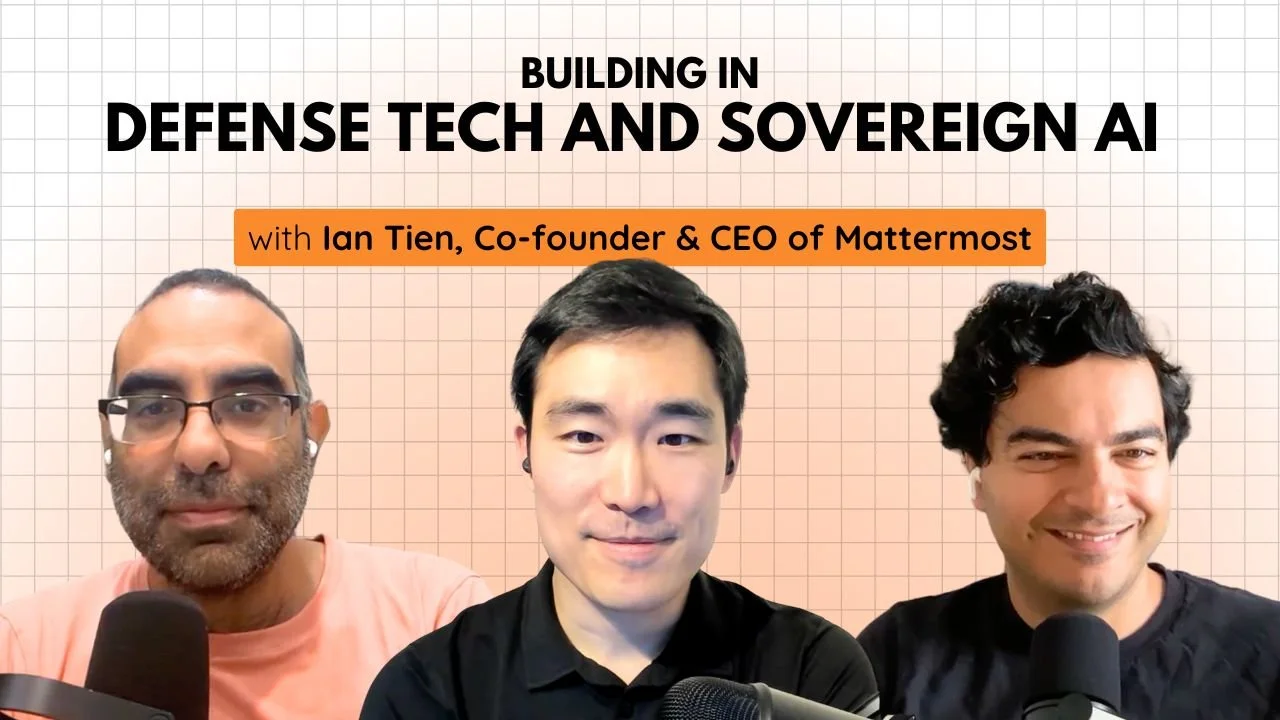
Mattermost founder Ian Tien shares lessons on sovereign AI, defense tech, enterprise sales, and building an open-source company in national security.
In this episode of the Founders in Arms podcast, we sit down with Ian Tien, founder and CEO of Mattermost, to explore one of the most important emerging categories in tech: sovereign AI and defense software.
Ian shares how Mattermost evolved from an open-source Slack alternative into a mission-critical collaboration platform used in national security environments—and what founders need to understand about building in this space.
This conversation dives deep into:
What “sovereign AI” actually means
Why governments care about owning their tech stack
How open source enabled bottom-up adoption in defense
Lessons from selling into government and enterprise
The realities of defense tech vs Silicon Valley startups
How AI is reshaping national security
Why supply chain security is the new frontier
What founders get wrong about defense tech
In this episode, we cover:
(00:00) The rise of sovereign AI
Governments around the world are investing heavily in sovereign AI.
The goal:
Reduce dependence on external systems
Control their own infrastructure
Strengthen national resilience
This shift is becoming a core part of national security strategy.
(04:08) What Mattermost actually does
Mattermost started as an open-source alternative to Slack.
Today, it has evolved into:
A self-hosted collaboration platform
Workflow and automation tools
Secure communication infrastructure
It’s designed for environments where security and control are critical.
(05:33) From gaming startup to enterprise software
Mattermost’s origin is unexpected:
Started as a gaming company
Built internal tools for reliability
Turned those tools into a product
This mirrors companies like Slack and Discord, which also emerged from gaming roots.
(07:54) The concept of “sovereign collaboration”
If governments want sovereign AI, they also need:
Sovereign collaboration.
That means:
Self-hosted systems
No external dependencies
Secure, multi-user workflows
This is where Mattermost fits.
(08:11) Bottom-up adoption in national security
One of the most surprising insights:
Mattermost spread inside defense environments organically.
Why?
Better UX than existing tools
Easy to deploy
Open source accessibility
Teams adopted it before leadership formally approved it.
(09:21) Open source as a distribution strategy
Open source enabled:
Rapid experimentation
Trust through transparency
Bottom-up enterprise adoption
Eventually:
Organizations upgrade to enterprise versions
Revenue follows usage
(10:27) The reality of VC money
Ian shares a candid lesson:
Taking VC isn’t the problem—spending it poorly is.
Examples:
Overspending on non-essential items
Hiring before understanding the market
Scaling without clear product-market fit
Profitability forced better discipline.
(13:28) Why capital alone doesn’t solve growth
Money only works if:
You understand your customer
You have the right go-to-market strategy
You invest in the right areas
Otherwise, it accelerates mistakes.
(14:18) Learning an entirely new industry
Moving into defense required learning:
Government procurement
Military terminology
Security classifications
Enterprise sales cycles
It’s essentially learning a new language.
(14:25) The “acronym problem” in government
Selling into defense means navigating:
DoD terminology
Security levels (IL4, IL5, etc.)
Complex procurement processes
Understanding the language is critical to credibility.
(17:23) How to learn a new domain quickly
Ian’s approach:
Attend industry conferences
Spend time in-person with customers
Immerse yourself in the ecosystem
There’s no shortcut—exposure compounds.
(19:00) The CEO job: hardest problems only
The CEO’s role is simple (but hard):
Work on the hardest problems in the company.
That includes:
Biggest risks
Biggest opportunities
Cross-functional challenges
(24:49) Hiring executives like co-founders
Ian emphasizes:
Executives should feel like partners, not employees.
Key traits:
Long-term alignment
Trust and ownership
Ability to scale with the company
(26:34) What makes a great executive
Look for:
Experience at different company stages
Both success and failure (“scar tissue”)
Ability to operate under uncertainty
These traits matter more than pedigree.
(30:50) AI + defense = massive global shift
Two major investment areas in 2025:
AI
Defense
Governments are increasing defense spending dramatically, creating massive opportunities for startups.
(31:00) Why sovereign AI matters globally
Countries want:
Control over their AI systems
Visibility into supply chains
Independence from foreign influence
This is driving demand for local models and infrastructure.
(34:28) The importance of supply chain security
AI is now part of the software supply chain.
Risks include:
Compromised open-source components
Foreign influence in models
Hidden vulnerabilities
Security is becoming a top priority.
(38:52) Advice for defense tech founders
The biggest mistake:
Staying inside the building.
Instead:
Meet customers in person
Attend defense conferences
Understand real-world problems
This space rewards proximity to users.
(42:07) Is defense tech really slow?
Common belief:
Government sales take years.
Reality:
It’s similar to enterprise sales
Slow if you don’t know the system
Fast if you understand the process
(47:02) Understanding government buying models
There are three main approaches:
Butts-in-seats contracting (services-heavy)
Commercial off-the-shelf software (COTS)
Hybrid platforms (e.g. Palantir-style)
Each has different incentives and tradeoffs.
(50:00) Why software procurement is broken
Government systems are optimized for hardware, not software.
Result:
Slow procurement
Inefficient processes
Difficulty adopting modern SaaS
This is slowly changing.
Key Takeaways for Founders
Sovereign AI is a massive emerging category
Governments want control over their AI and infrastructure.
Open source can unlock unexpected markets
Bottom-up adoption can reach even national security environments.
Capital without clarity is dangerous
Money amplifies both good and bad decisions.
Defense tech is learnable—but requires immersion
You must understand the language, culture, and systems.
Enterprise and government sales are similar
Both require trust, relationships, and patience.
AI introduces new supply chain risks
Security and governance will define the next wave of winners.
About the Guest
About Ian Tien
Ian Tien is the founder and CEO of Mattermost, an open-source collaboration platform used by enterprises and governments worldwide.
He previously worked at Microsoft and Trilogy, and has spent over a decade building software for secure, mission-critical environments.
Listen to Founders in Arms
Founders in Arms is a podcast for builders—covering startups, AI, enterprise software, and the realities of company building.
🎙 Subscribe to Founders in Arms Podcast on your favorite platform
💬 Join the conversation at TribeChat.com
🚀 Discover more founder insights
