
Noah Smith joins Founders in Arms
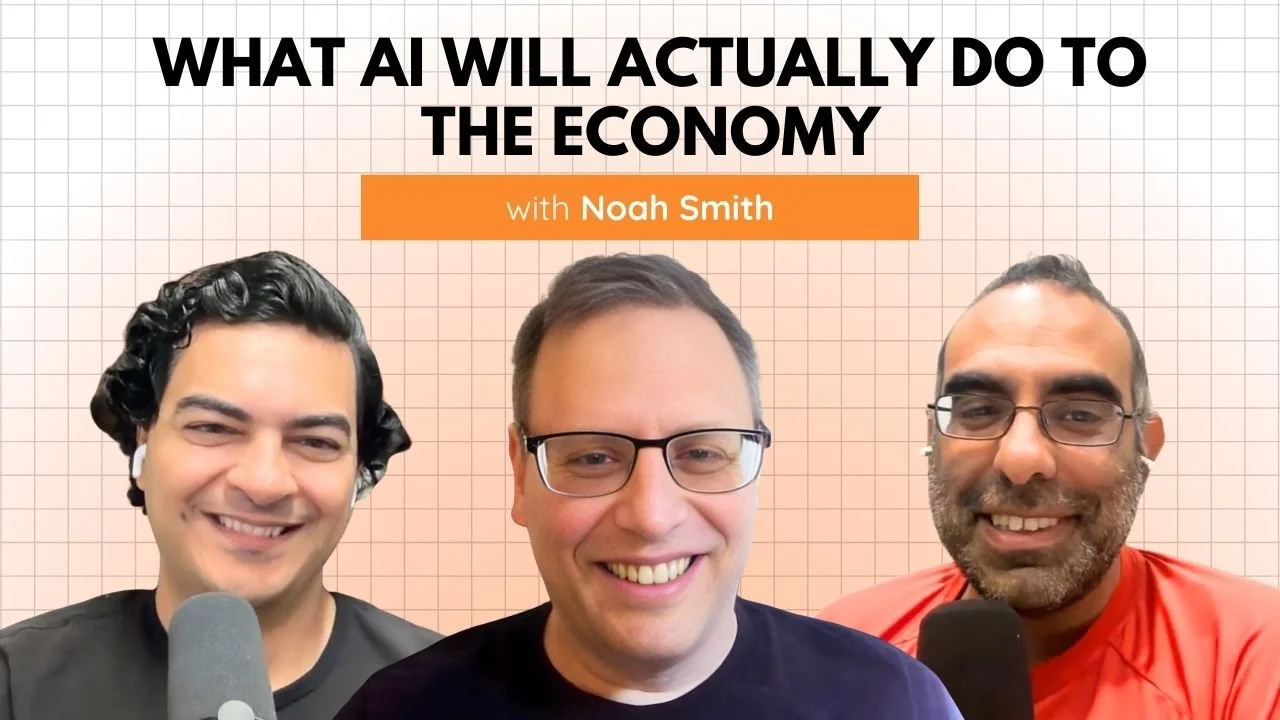
Economist Noah Smith joins Founders in Arms to discuss AI’s impact on jobs, markets, productivity, and why the real threat may not be the economy—but AI-enabled bioterror.
In this episode of the Founders in Arms podcast, we sit down with economist and writer Noah Smith to discuss AI’s potential impact on the economy, financial markets, employment, and global risk.
Noah argues that while many people are focused on whether AI will cause unemployment or disrupt specific industries, the real risks may be far more serious. He explains why predictions of an AI-driven financial crisis may be overstated, how productivity shocks could temporarily create recessions, and why emerging technologies could introduce entirely new kinds of global threats.
The conversation also explores why markets sometimes fail to anticipate major disruptions, how AI could reshape labor markets, and why humility is essential when making predictions about technological change.
This conversation dives deep into:
AI and financial market reactions
The “Citrini” AI disruption thesis
Productivity shocks and recession risk
AI-driven job displacement
Sticky prices and macroeconomic adjustment
Biotechnology risks from AI tools
Software engineering productivity gains
Why economic forecasting is so difficult
In this episode, we cover:
(00:00) The “meteor meme” and AI risk
Noah introduces a meme where dinosaurs see a giant meteor approaching and say, “Oh, the economy.”
He uses it as a metaphor for AI risk: people may be focusing on economic disruption while ignoring much larger existential risks.
(02:19) What the Citrini AI thesis argued
The hosts discuss a widely shared analysis imagining how AI could disrupt industries and trigger cascading economic effects.
The scenario suggests AI could compress profit margins across sectors, destabilize companies, and eventually trigger a financial crisis similar to 2008.
(04:32) Why markets often miss major events
Noah explains why he is skeptical of claims that markets always price in future risks.
He points to the COVID pandemic as an example: despite clear warning signs from epidemiology models, markets reacted only after the crisis was already unfolding.
(06:18) Why the Citrini post moved markets
Noah argues the post gained attention because it framed AI disruption in terms people already understood.
By comparing AI disruption to the 2008 financial crisis, it triggered strong reactions from investors who remembered that event.
However, he believes the analogy itself is weak.
(07:56) The financial crisis domino theory
The thesis suggested that AI could reduce profits for companies like DoorDash, Visa, or software firms.
Lower profits could lead to stock declines, which could trigger failures in leveraged loans and private credit markets, eventually causing systemic financial stress.
(08:41) Noah’s verdict: possible but unlikely
Noah says the scenario is theoretically possible but highly unlikely.
Corporate balance sheets today are far less leveraged than before the 2008 crisis, and most technology companies are not dependent on fragile debt structures.
Even large profit shocks would probably not destabilize the financial system.
(11:06) AI productivity and software engineering
AI tools are already increasing coding productivity.
Engineers using AI assistants can ship more software with fewer people, and this trend will likely accelerate as tools improve.
The question becomes whether demand for software grows enough to absorb these productivity gains.
(13:56) Where AI job losses might appear first
Noah believes the earliest disruptions may occur in clerical or administrative work.
Roles involving routine information processing—such as bookkeeping, support roles, or paperwork-heavy hospital administration—could see automation sooner than high-skill engineering jobs.
(17:31) Can productivity increases cause recessions?
Noah explains a counterintuitive economic concept: productivity booms can temporarily cause recessions.
If productivity increases rapidly but prices cannot adjust quickly enough due to “sticky prices,” demand can collapse temporarily.
This creates short-term economic contraction despite higher long-term productivity.
(19:50) Noah’s biggest AI fear: bioterror
While many discussions focus on jobs or economic disruption, Noah says his biggest concern is AI-enabled biotechnology.
Advances in protein modeling and automated labs could make it easier to design and synthesize dangerous viruses.
This could dramatically lower the barrier for individuals to create biological threats.
(24:54) AI risk vs geopolitical risk
Noah previously cited China–Taiwan conflict as a major global risk.
He now believes AI-enabled biotechnology may represent an even greater long-term threat.
(25:13) The current state of the economy
Noah believes inflation is largely under control and will likely stabilize slightly above the Federal Reserve’s target.
He also expects strong productivity growth driven partly by AI.
(28:02) AI’s impact on hiring
Companies may hire fewer workers in some roles while hiring more in others.
For example, engineers building AI-powered systems may increase productivity across sales, marketing, and operations teams.
This could slow hiring in non-technical roles while increasing demand for technical talent.
(31:17) What happened to software engineering jobs
Software hiring slowed in 2023–2024, partly due to pandemic overhiring and macroeconomic conditions.
However, Noah suggests companies may also have paused hiring because they were uncertain about how AI would affect engineering productivity.
(34:42) The long-term uncertainty around automation
Predictions about automation are often wrong until they suddenly become right.
For example, people predicted the internet would destroy publishing for years before the actual collapse occurred—triggered by social media rather than blogs or search engines.
(35:50) Why intellectual humility matters
Noah says intellectual humility has been one of his biggest advantages as an analyst.
Many commentators confidently predict dramatic outcomes, but history shows technological transitions often unfold unpredictably.
Acknowledging uncertainty can lead to better long-term forecasting.
(39:31) The real AI risk
Noah ends the conversation by returning to the meteor meme.
He argues society may be focusing heavily on AI’s economic impact while ignoring potentially larger risks from superintelligence and biotechnology.
The real question may not be whether AI disrupts jobs—but whether humanity can safely manage technologies that may soon surpass human capabilities.
Key Takeaways for Founders
Markets are not always forward-looking
Even sophisticated financial markets can miss major risks until they are already unfolding.
Productivity shocks can create temporary recessions
Rapid technological improvements can disrupt economic balance before prices and wages adjust.
AI may shift jobs rather than eliminate them
Productivity gains could reduce hiring in some roles while increasing demand in others.
Economic forecasting requires humility
Technological predictions often fail because the real impact arrives through unexpected channels.
The biggest risks may not be economic
AI could introduce entirely new categories of global risk, particularly in biotechnology and autonomous systems.
About the Guest
About Noah Smith
Noah Smith is an economist and writer best known for his Substack newsletter Noahpinion. His work focuses on macroeconomics, technology, geopolitics, and the future of the global economy.
He previously worked as an assistant professor of economics and has become one of the most widely read economic commentators on technology and policy.
Listen to Founders in Arms
Founders in Arms is a podcast for ambitious builders—covering startups, AI, economics, markets, and the realities of building companies in times of technological change.
🎙 Subscribe to Founders in Arms on your favorite platform.
💬 Join the conversation at TribeChat.com.
🚀 Discover more insights from founders and operators shaping the future of technology.
