
Parag Agrawal joins Founders in Arms
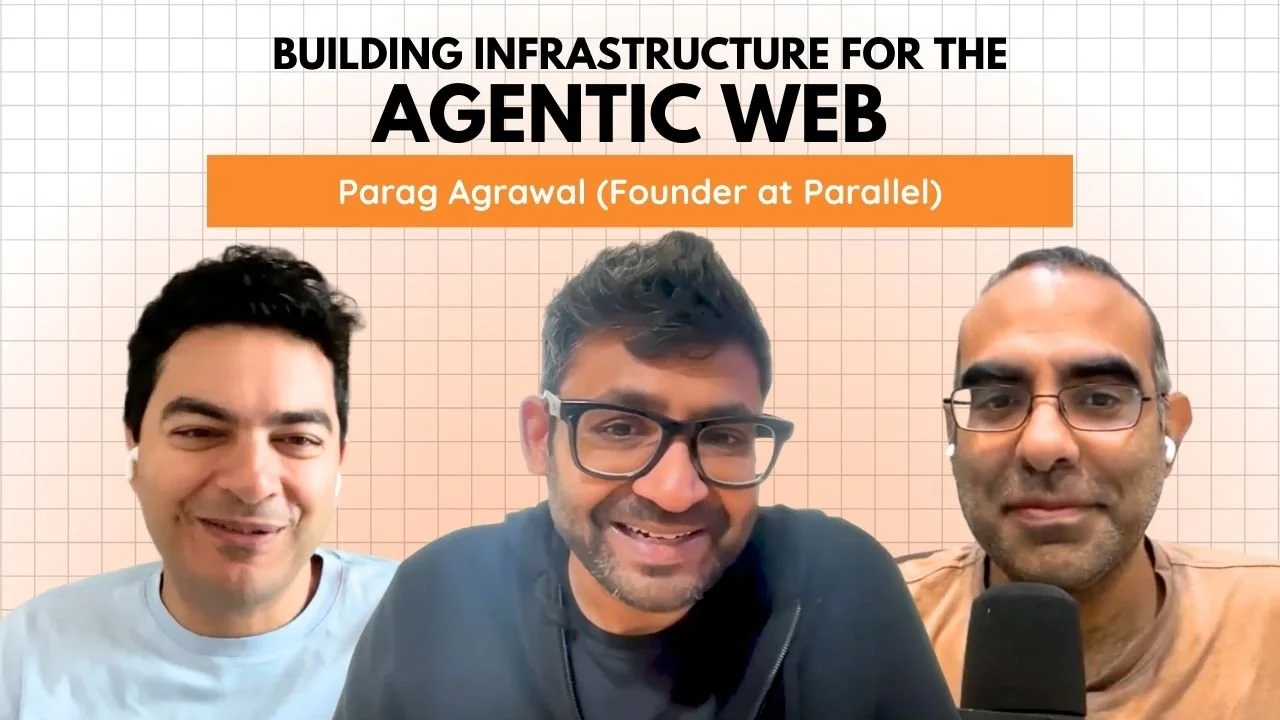
Parag Agrawal joins Founders in Arms to discuss the agentic web, Parallel’s $100M Series B, AI infrastructure, startup lessons, and the future of web automation.
In this episode of the Founders in Arms podcast, we sit down with Parag Agrawal—former Twitter CEO and co-founder of Parallel—to discuss the rise of the agentic web, building infrastructure for AI agents, raising a $100M Series B, and what founders get wrong about fundraising.
This conversation dives deep into:
AI agents and web infrastructure
Startup conviction before product-market fit
New business models for web content
Compounding product decisions
Fundraising psychology
In-person vs remote company culture
If you're building in AI, SaaS, fintech, or enterprise software, this episode is packed with tactical insight and long-term thinking.
In this episode, we cover:
(00:00) Introduction and Parallel’s mission
Parag Agrawal explains why the “agentic web” is still early—but moving fast. Today, most agents are basically models + a set of tools (like web search). The next shift, he argues, is toward:
Sub-agents (more autonomous work than a single tool call)
A transition from pull to push on the web
Instead of constantly searching, you’ll be able to say:
“When X happens in the world, notify me so my agent can act.”
(01:02) What Parallel’s APIs enable for AI agents
Parallel builds APIs that let AI agents access the web effectively.
Parag’s thesis: as the primary consumer of the web shifts from humans to agents, much of today’s web architecture becomes outdated.
If agents become the main “readers,” infrastructure must be rebuilt around:
Speed
Reliability
Structured, high-density outputs
Agent-native workflows
Parallel is building that foundational layer.
(02:43) Practical examples: coding agents, sales automation, research
Parallel’s APIs power agents across industries:
Coding agents
Fetch documentation
Pull reference material
Do competitive research
Troubleshoot issues
Sales automation
Prospect research
Account prioritization
CRM enrichment
Finance & insurance
Underwriting workflows
Public risk monitoring
Competitive intelligence
Due diligence automation
Research workflows
Deep research across scientific papers
Cross-source analysis
Structured database generation
Parallel focuses on making web access “agent-ready” so agents can take the next action without excessive tool calls.
(04:57) The conviction bet on agents before the market existed
When early open-source agents like AutoGPT were emerging, models weren’t yet strong enough—but the direction was clear.
Parallel made a conviction bet:
If models improve, agents will become powerful—and they will need new infrastructure.
They built ahead of the market, knowing adoption would lag capability.
(10:54) New business models for content in the agentic web
Much of the internet is funded by ads.
But if agents browse instead of humans:
They don’t see ads.
They don’t click banners.
Publishers lose revenue.
Parag argues we need new economic models for the open web.
He compares this moment to the evolution of the music industry:
Piracy
Licensing
Streaming
The key challenge:
How do you create scalable incentives for high-quality content while keeping the web open?
Parallel is exploring publisher partnerships—but inventing a new business model at web scale is extremely hard.
(20:22) The $100M Series B fundraise and going public
Parallel raised a $100M Series B, co-led by Kleiner Perkins and Index.
The early pitch was unusual:
“These APIs are too slow for humans—but agents are asynchronous.”
At first, the market wasn’t ready. But as crawling, indexing, and performance improved—and AI agents became more viable—traction accelerated.
The fundraising followed product-market alignment.
(23:03) Why Parallel built in stealth with carefully chosen early customers
As an API-first company, Parallel knew API design decisions would be long-lived.
Advice Parag followed:
Once many customers depend on your API, you can’t easily change it.
So they:
Worked with a small number of close partners
Iterated aggressively
Made breaking changes early
Refined API shape before scaling
(24:55) Current scale and product offerings
Parallel was already handling millions of queries per day early on.
Their API pricing spans:
Low-cost calls (fractions of a cent)
High-cost agentic workflows ($50–$100+ per call)
Example: generating a full structured startup database from a natural-language query—returning significantly more comprehensive results than shallow research tools.
(30:42) The evolution from tools to sub-agents to push-based web
The market is moving from:
Tools for agents →
Sub-agents that perform larger autonomous tasks →
Push-based monitoring
Instead of querying constantly, users subscribe to change:
“When something actionable happens on the open web, notify me.”
Parallel has already shipped an early alpha in this direction.
(33:13) Are we in an AI bubble? Parag’s nuanced perspective
Parag’s view:
In 5–8 years, this won’t feel like a bubble.
But there could be short-term overcorrection if capital gets misallocated.
A warning sign: “We need AI” before clearly defining the problem.
Parallel scales spending with traction:
Aggressive when revenue grows
Disciplined when growth slows
(36:34) The mental models behind fundraising vs customer rejections
Parag’s mindset:
In fundraising, you only need one yes.
With customers, you need many yeses to win the market.
Customer rejections hurt more—because they directly test product truth.
(38:37) Why VC enthusiasm is rational strategy, not signal
VC excitement is rational behavior.
Investors signal enthusiasm to:
Stay in the deal
Gather information
Maintain optionality
It’s not necessarily a commitment—it’s part of the game.
(45:37) Biggest career mistake: delaying Twitter’s algorithmic timeline
Parag’s biggest regret: not shipping Twitter’s algorithmic timeline sooner.
The delay cost months of compounding growth.
(48:28) The compounding cost of six-month delays
If a feature drives growth:
Shipping six months earlier compounds forward indefinitely.
Every year the regret increases.
It’s a powerful lesson for founders: ship early in compounding systems.
(50:09) Finding inspiration in “re-founders” like Satya Nadella
Parag draws inspiration from leaders who reshape companies from within—like Satya Nadella at Microsoft.
Being a founder is often more about mindset than job title.
(51:54) The most rewarding part: watching customers do unexpected things
The most exciting moments at Parallel come from customers using the product in unexpected, futuristic ways.
Those moments reveal where the future is heading.
(52:43) In-person culture and the transition to remote-friendly
Parallel began as strongly in-person:
Whiteboards instead of task managers
Minimal dial-ins
Strong office culture
As the company scales, they’re introducing flexibility—but Parag emphasizes that hybrid work requires intentional structure.
Key Takeaways for Founders
Build ahead of markets—but only with conviction.
API shape decisions are long-lived.
Compounding systems punish hesitation.
Fundraising is a game of optionality.
AI infrastructure will reshape how the web is monetized.
Listen to Founders in Arms
Founders in Arms is a podcast for ambitious builders—covering startup strategy, fundraising, AI, fintech, and the realities of scaling companies.
If you’re building in AI or SaaS, this is required listening.
🎙 Subscribe to Founders in Arms on your favorite platform.
💬 Join the conversation at TribeChat.com.
🚀 Discover more insights from top founders and operators shaping the future of tech.
