
Sahil Lavingia joins Founders in Arms
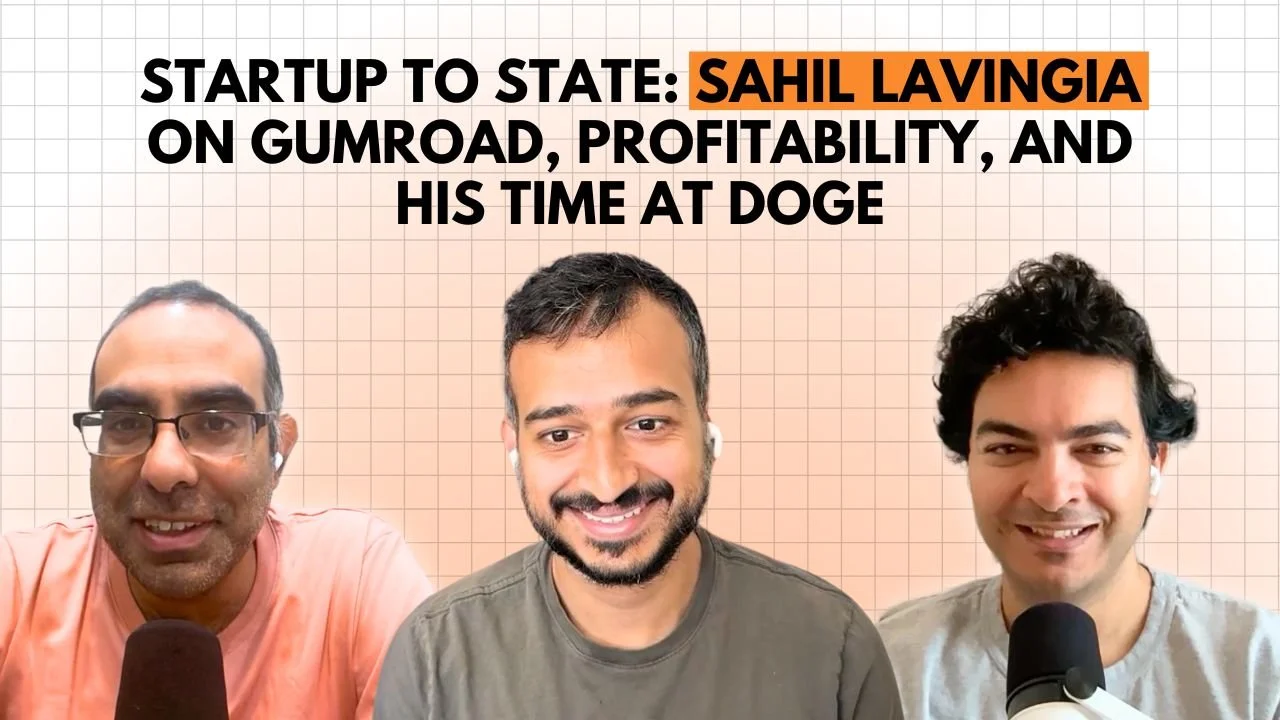
Sahil Lavingia on Gumroad, DOGE, AI Coding Tools, and Building a Profitable Tech Company
In this episode of the Founders in Arms podcast, we sit down with Sahil Lavingia—founder and CEO of Gumroad, former Pinterest employee, and one-time software engineer inside DOGE at the Department of Veterans Affairs—to talk about startups, government software, AI coding, and alternative paths to building enduring tech companies.
Sahil shares how he dropped out of college to join Pinterest, started Gumroad shortly after, raised venture capital from Kleiner Perkins, and eventually turned the business into a profitable company that pays dividends and runs tender offers.
The conversation also dives into his short but fascinating time inside government, where he worked on contract review automation and software projects at the VA, as well as how AI coding tools are changing engineering, hiring, and product development.
This conversation dives deep into:
Dropping out of college for startups
Building and scaling Gumroad
Turning a venture-backed startup into a profitable company
DOGE and software inside government
AI coding tools like Cursor and Devin
How to evaluate engineers in the AI era
Dividends, buybacks, and alternative startup outcomes
In this episode, we cover:
(00:00) What DOGE actually focused on inside government
Sahil opens by explaining his view of the DOGE agenda.
He breaks it into three main areas:
cutting contracts
helping with reduction in force
shipping software
His takeaway is that software mattered, but in practice most of the energy went into the first two areas, with less room than he expected to actually build technology.
(01:13) Dropping out of college to join Pinterest
Sahil talks about dropping out of USC to join Pinterest as employee number two, working on the iPhone app.
He explains that at the time, this felt like a rare window of opportunity tied to:
the rise of iPhone apps
the App Store
the early startup wave around mobile
He still recommends the path of building things, posting them online, and using communities like Hacker News to attract opportunities.
(05:23) Why he started Gumroad so quickly after Pinterest
Sahil left Pinterest after only a short time and started Gumroad soon after.
He reflects that this move may have been too accelerated in some ways, since staying longer might have helped him build:
more operating experience
a stronger network
a more developed product point of view
Still, he was driven by momentum and the startup path laid out in Silicon Valley at the time.
(07:58) Why senior engineers matter more in the AI era
Sahil shares a sharp view on how AI is changing engineering talent.
His argument is that junior engineers may be at a disadvantage now because AI tools can already handle much of the lower-level coding work.
That shifts the bottleneck toward things like:
software architecture
breaking complex problems into smaller parts
knowing what tools already exist
research and product judgment
In his view, these are often more senior skills.
(11:00) The AI coding stack: Cursor, Devin, Claude, Gemini, and more
Sahil walks through the tools he uses most often.
His working setup today is roughly:
Cursor when he is coding directly on his laptop
Devin when he wants asynchronous work done through Slack
frontier models like Claude, Gemini, and others depending on task quality
He emphasizes how quickly the space is moving and how often the best tooling changes.
(12:44) What AI can and cannot do well in software today
Sahil gives a practical breakdown of what coding agents are good at now.
AI works especially well for:
simple front-end changes
API updates
tests and small bug fixes
documentation edits
isolated atomic tasks
It is much weaker when asked to independently handle larger changes that require coordinated planning across architecture, migrations, front-end, back-end, and product thinking.
That means humans still need to break work into manageable pieces.
(15:44) The most important engineering skills now
Sahil argues that two skills matter most in the AI era:
breaking big problems into smaller solvable units
knowing what tools and open-source systems already exist
In his view, research and product management have become unusually valuable because the actual typing of code is less of a bottleneck.
(20:15) Joining DOGE and the Department of Veterans Affairs
Sahil explains how he got involved with DOGE through a friend-of-a-friend connection and eventually joined the VA as a software engineer.
He says the original draw was the chance to:
resolve his own curiosity and FOMO
learn quickly inside a massive institution
have some direct impact within a short 60-day window
Because Gumroad was already profitable and stable, he felt uniquely able to step away temporarily.
(25:26) Reviewing 90,000 contracts with AI
One of the first projects Sahil worked on at the VA was using AI to review contracts.
The process involved:
extracting text from PDFs
running them through an internal GPT-style model
identifying contracts likely to be candidates for cancellation
He describes this as a practical example of where AI could save large amounts of human time, even if it was not making final decisions on its own.
(28:01) How contract-cutting decisions were actually made
Sahil explains that one of the hardest parts of the work was that contracts often lacked clear visibility into real-world utility.
In practice, the team focused on broad heuristics, including contracts that appeared less mission-critical to veterans, such as internal support functions or lower-priority services.
The model was used as a first-pass triage layer rather than a final authority.
(30:50) Why DOGE felt more adversarial than collaborative
A central theme of Sahil’s government experience is that DOGE often operated more like an external force trying to push change onto the system rather than a partner working alongside career staff.
He believes the effort would have been more effective if it had leaned harder into:
collaboration
shared problem-solving
empowering agency employees
training existing teams on better software tools
(33:03) Why government should hire more software engineers directly
Sahil says one of the clearest takeaways from his time at the VA is that agencies need more internal software engineering talent.
He contrasts this with the current structure, where large amounts of software work are outsourced through contracts to firms like:
Deloitte
IBM
Accenture
Booz Allen
His view is that even a small number of strong internal engineers could create outsized leverage.
(36:37) The case for private-sector talent rotating through government
Sahil, Immad, and Raj discuss the broader idea that talented operators and engineers from private industry should be able to spend short periods of time inside government helping modernize systems.
Sahil thinks this could be powerful if it were structured with:
more cooperation
less ideological framing
more transparency
stronger continuity after the initial project
He even suggests more government meetings and code should be public wherever possible.
(40:34) From venture-backed startup to profitable company
The conversation shifts back to Gumroad and one of the more unusual startup stories in tech:
a company that raised venture capital, could not raise the next round, but did not die.
Sahil explains that Gumroad was growing but not growing fast enough for venture standards, especially compared with companies like Patreon.
Rather than sell the business at a weak outcome, he chose to keep running it.
(43:01) How Kleiner Perkins sold its stake back for $1
In one of the most memorable moments of the episode, Sahil explains that Kleiner Perkins eventually offered to sell its Gumroad stake back to him for $1.
The likely reasons included:
fund life constraints
admin and audit burden
tax write-off benefits
That unusual event gave Sahil much more control over the company’s future.
(46:14) Why Gumroad now pays dividends and runs buybacks
Sahil describes Gumroad’s current operating model as closer to a private public company.
Instead of chasing venture growth forever, the company now:
pays dividends
runs regular buybacks and tender-like processes
gives liquidity to long-term shareholders
distributes a percentage of net income
He sees this as a compelling model for profitable software businesses that are not trying to become unicorns.
(49:59) Radical transparency and building in public
The episode closes with Sahil talking about Gumroad’s radical transparency.
For him, the benefits include:
marketing and brand building
helping other founders learn
improving his own standards
attracting creators who want to support an open company
forcing better execution because others can see the work
He thinks transparency generally makes organizations better, even if it is not the right move for every company.
Key Takeaways for Founders
AI makes senior judgment more valuable, not less
As coding becomes easier, architecture, research, and product management matter more.
Profitable startups have more strategic freedom
Because Gumroad was stable and cash-generating, Sahil could explore opportunities like DOGE without risking the company’s survival.
Government modernization needs internal technical talent
Outsourcing everything creates long feedback loops and weak product ownership.
There is a path after venture capital
A startup that falls off the venture path does not have to die or sell immediately. It can become a durable, profitable company.
Dividends and buybacks are underused in tech
Not every software company needs to follow the same venture-backed endgame.
Transparency can be a real advantage
Building in public can improve execution, attract aligned users, and help the broader ecosystem learn.
About the Guest
About Sahil Lavingia
Sahil Lavingia is the founder and CEO of Gumroad, a platform that helps creators sell digital products and earn money online.
He was previously one of the earliest employees at Pinterest, where he worked on the iPhone app after dropping out of USC. Over the years, Sahil became known for building Gumroad in public, sharing financials openly, and experimenting with alternative models for running software companies.
He also briefly served as a software engineer inside DOGE at the Department of Veterans Affairs, where he worked on contract review automation and software modernization efforts.
Listen to Founders in Arms
Founders in Arms is a podcast for ambitious builders—covering startup strategy, AI, fintech, SaaS, and the realities of building and scaling companies.
🎙 Subscribe to Founders in Arms on your favorite platform.
💬 Join the conversation at TribeChat.com.
🚀 Discover more insights from founders and operators shaping the future of tech.
