
Why Padel is Replacing Golf as the Bay Area's Networking Sport
Why Padel is Replacing Golf as the Bay Area's Networking Sport
A founder in our community posted something a few weeks ago that kicked off one of the more interesting threads we've had. He'd been trying to close a business introduction for months. Emails, coffee meetings, the whole routine. Didn't go anywhere in particular. Then someone suggested padel at Treasure Island. Ninety minutes on the court together later, the relationship had moved further than it had in four months of calendar-coordinating.
His explanation for why was worth thinking about: "You just can't fake anything on a padel court. How someone handles a bad shot, whether they communicate with their partner, whether they get competitive in a weird way or stay generous when the game gets close... you learn more about a person in an hour of padel than in six coffee meetings."
This is the conversation happening more and more across the Bay Area's professional community right now. And it raises a genuinely interesting question: is padel replacing golf as the sport of choice for building real professional relationships in the Bay? The honest answer is: for a specific generation of professionals in this specific region, yes. Increasingly, yes.
Here's why.
What Made Golf Work (And Why It Worked Less Well Than People Admit)
Golf became the networking sport of the 20th century corporate world for real reasons. A round of golf takes four to five hours, which means sustained time with someone in a context that's distinct from the office. The format is episodic (hole by hole) which creates natural moments for conversation. The sport rewards patience and emotional control, which made it a useful signal for certain professional cultures. And the exclusivity of club membership created a shared identity that reinforced professional networks.
But there are also things golf doesn't do particularly well that nobody talks about much. It's not actually that communicative as an activity. You play alongside people more than with them. A four-person golf round involves less genuine interaction than you might expect because everyone is focused on their own shot for most of the time. The "bonding" often happens between holes or at the 19th hole after, not during the sport itself.
It's also genuinely hard. The learning curve for golf is long enough that bringing someone who's never played (or played badly) into a networking round creates an awkward dynamic rather than a connecting one. And in the Bay Area specifically, the culture skews young, international, and not particularly golf-native, which means the sport's networking power here was always more limited than in, say, the Dallas business community.
Why Padel Creates a Different Kind of Connection
Padel is structurally different from golf in ways that turn out to matter a lot for the networking context.
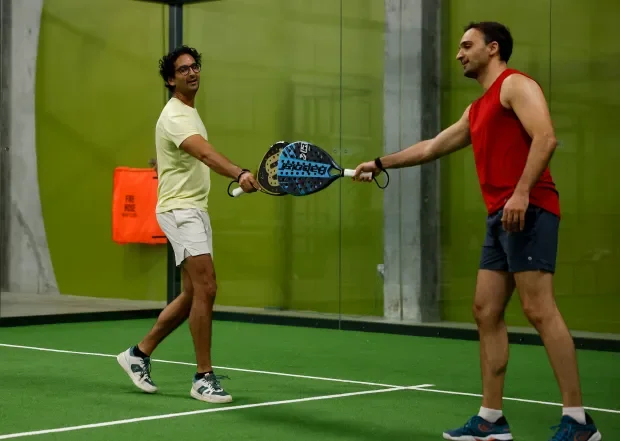
It's always played doubles. You are always communicating with a partner and always playing against two other people. Every point requires coordination, split-second decisions about who takes the ball, verbal calls, and genuine cooperation. You cannot be a silent participant on a padel court the way you can on a golf course. The sport forces interaction in a way that's actually useful for relationship building.
The enclosed court creates a specific social intensity that open-air sports don't have. Four people in a glass box for 90 minutes, with clear walls on all sides, creates a physical intimacy that's unusual in a professional context and (when it works) genuinely accelerating for relationships. You're close to each other. You can hear each other's reactions. There's nowhere to retreat to between points.
The learning curve is much more forgiving than golf. Most people can play a real, fun, competitive game of padel within their first three or four sessions. Which means you can bring a business contact who's never played and have a genuinely enjoyable shared experience rather than an awkward one where the skill differential makes everyone uncomfortable. The sport meets people where they are fast enough that the game itself doesn't get in the way of the relationship.
And the time commitment is right. Ninety minutes. Not four hours. Bay Area professionals are not people who have four hours on a Tuesday afternoon in large quantities. An hour and a half on a weeknight or a weekend morning that ends in time for everything else works for the schedules that actually exist here.
What's Happening at Bay Padel Sunnyvale Specifically
The Sunnyvale location is where the tech-community-padel overlap is most visible and most reported on. The Google campus adjacency is part of it (the sport has genuine penetration inside major tech companies' internal cultures at this point, with Slack channels, regular group bookings, and informal tournaments organized at the company level). But it's also just the demographics of Silicon Valley professional life concentrating around a sport that fits its rhythms.
What the Sunnyvale regulars describe is a scene that functions like a club within a club. There are people who book the same courts at the same times every week and who have built genuine professional relationships through the recurring contact. Introductions happen between games. Follow-up conversations start from something that came up on the court. The sport creates enough shared context and shared experience that the professional relationship feels grounded in something real rather than purely transactional.
This is, incidentally, exactly what golf does at its best in the communities where it works. Padel just does it in 90 minutes, without requiring a $50,000 club membership, in a format that's accessible to a 28-year-old who grew up in Mumbai or São Paulo and has never swung a club in their life.
The Specific Things You Learn About Someone on a Padel Court
This keeps coming up in community conversations when people try to articulate why padel specifically seems to work for professional relationship building, and it's worth being concrete about.
How someone handles losing a point tells you a lot. Do they blame their partner (red flag in a professional context, by the way)? Do they laugh it off and reset? Do they get visibly frustrated in a way that affects the next three points? People's patterns under competitive pressure in a low-stakes sport context are usually pretty consistent with their patterns under professional pressure. It's not a perfect signal but it's a real one.
How someone communicates with their partner under pressure is even more useful. Padel requires constant short, clear communication: "yours," "mine," "back," "switch." People who communicate well in those moments tend to communicate well generally. People who go silent when things get difficult on the court often go silent when things get difficult in other contexts too. You're essentially watching a 90-minute communication style demonstration and most people don't realize they're giving it.
Whether someone is generous in how they play: do they set their partner up for the good shot or try to take everything themselves? Do they acknowledge when their partner makes a great play? Are they the person who brings energy when the team is down or the person who visibly disengages? These things are genuinely informative about character and they show up on the court in ways they don't always show up over coffee.
The Practical Version: How to Actually Use Padel for Networking
If you're reading this thinking "okay, this makes sense, how do I actually do it," here's the practical version.
The format that works best is two pairs who know each other in some configuration: you and a business contact versus two other people, or you and a colleague versus a contact and their colleague. This creates built-in team dynamics (you're on the same side as someone) while still giving you competitive shared experience with the people you're meeting. It's more connecting than the contact watching you play, which is passive, and less intense than pairing with a stranger from the very beginning.
Don't frame it as a meeting. Frame it as "I've been playing padel lately and I think you'd really enjoy it, want to come try it" and then let the relationship happen on the court rather than trying to conduct business there. The professional value comes from the relationship that builds through the shared experience, not from a pitch during a water break.
The Embarcadero or Treasure Island are both natural choices for this because the settings are genuinely impressive to bring someone to for the first time (Bay views, the hangar ceiling) which makes the invitation itself more compelling than "want to go to a court in a parking lot."
And if you want to find others in the Bay Area professional community who are already using padel this way, the Bay Area Padel Community is the place to do it. There are founders, operators, investors, and pretty much every other category of Bay Area professional in the tribe, and the dynamic on court tends to be pretty egalitarian in a way that makes the networking feel natural rather than forced.
Golf isn't going anywhere. But for a generation of Bay Area professionals who aren't golf natives, who don't have four-hour windows on weekday afternoons, and who work in environments where international backgrounds are the norm rather than the exception, padel is filling the same role more efficiently and more enjoyably. The court is small, the game is fast, the communication is constant, and ninety minutes later you know the person across the net in a way that months of emails couldn't get you to.
That's a pretty compelling pitch. Even if you never think about it as networking at all.
