
Max Mullen joins Founders in Arms
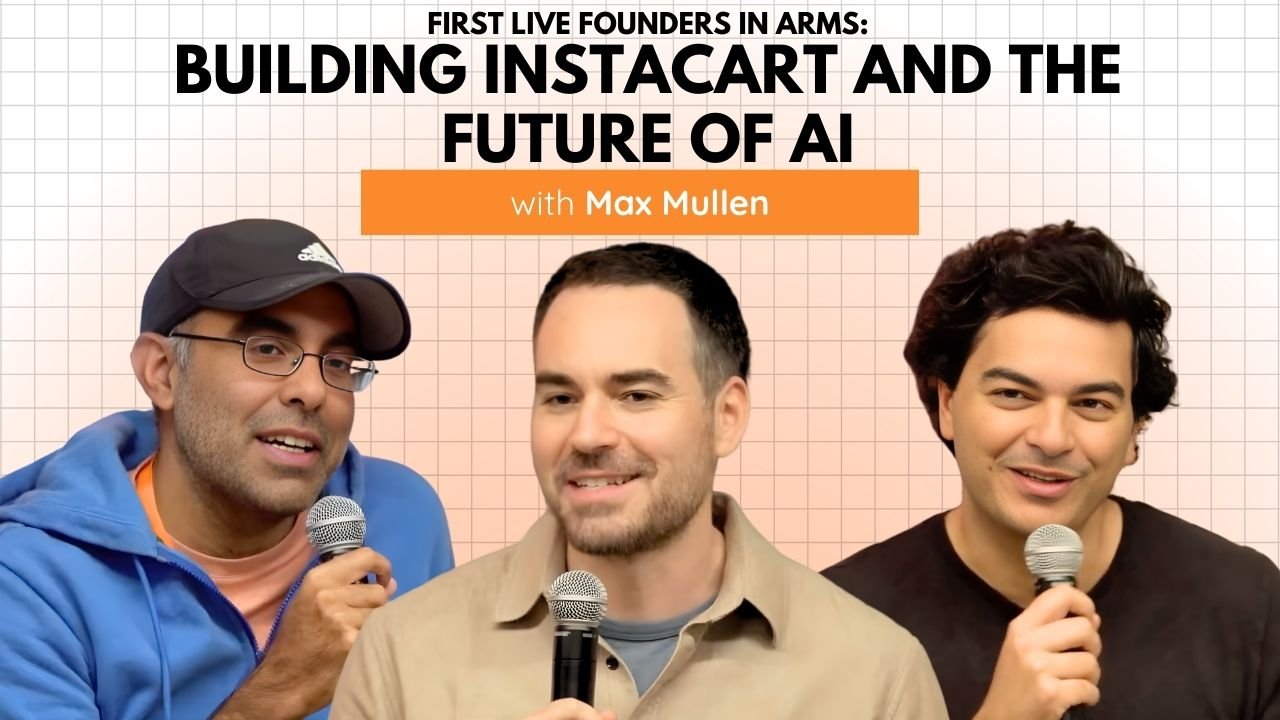
Max Mullen, co-founder of Instacart, joins Founders in Arms to discuss building Instacart, finding product-market fit, startup culture, acquisitions, fundraising, and where AI will create the next big startups.
In this live episode of the Founders in Arms podcast, we sit down with Max Mullen, co-founder of Instacart, to talk about how Instacart got started, what unlocked its early growth, how founder roles evolve as companies scale, and what makes startup culture actually stick.
Max shares the early story of getting into Y Combinator, why Instacart looked impossible in 2012, and the marketplace insight that helped turn it into a breakout company. He also explains how he thinks about acquisitions, what he looks for as an angel investor, and why the biggest startup opportunities in AI may come from building agent-powered tools for specific professions.
This conversation dives deep into:
Building Instacart in the early mobile era
The YC “hack” story
Marketplace product-market fit
How founder roles change over time
Operationalizing startup culture
M&A and acquihires
What investors actually look for in founders
The current VC market
Vertical AI agent startups
In this episode, we cover:
(00:00) The first live Founders in Arms event
Immad and Raj open the podcast’s first live Founders in Arms event in Mercury’s San Francisco office.
They talk about why they started the show, why founders learn so much from one another, and why building community around founders has always been the point.
Raj says one of the biggest moats a founder can have is pain tolerance, and that hearing how other founders survive hard moments can be deeply energizing.
(02:41) Introducing Max Mullen
Immad introduces Max Mullen as a longtime friend, early Mercury investor, Instacart co-founder, and former Chief Product Officer.
He also points out that Max has spent years both operating and investing, which makes him a uniquely useful guest for founders.
(04:00) How Max became a founder
Max says he grew up in Los Angeles and got into startups through hackathons and startup events around 2010.
His first startup came out of Startup Weekend, where he met a co-founder and built a social messaging product that helped groups of friends figure out what to do in the real world.
The product had some early recommendation ideas built into conversations, but the startup ultimately did not work and was acquired after about a year.
(05:36) The journey from acquihire to Instacart
After the acquihire, Max and his co-founder moved to the Bay Area and worked at the acquiring company for a short time.
That experience taught them a lot, but Max quickly realized he did not want to spend his career working for someone else.
He started thinking about ideas again and decided he wanted to do something very different from a social network:
something in the real world
something operationally hard
something that solved an important problem
That process eventually led to the idea that became Instacart.
(07:15) Why Instacart looked like a terrible idea in 2012
Max explains that when Instacart started, the idea looked extremely risky.
There was no UberX yet, no DoorDash, and no broad consumer habit around on-demand delivery.
Even worse, earlier grocery delivery startups had already failed, so many investors assumed the category was broken.
But Max says the team believed the timing had changed because of:
smartphones
mobile apps
greater internet adoption
less friction in e-commerce
From first principles, they believed those differences made the idea newly possible.
(08:23) The famous Y Combinator beer story
Raj brings up the well-known story about Instacart getting beer delivered to Garry Tan after the YC deadline had already passed.
Max clarifies that they had not been rejected. They were simply late.
His co-founder wanted to impress Garry by showing the product in action, and that worked.
Instacart got brought into YC, and later the team published a blog post called How We Hacked YC, which made the story famous and briefly caused tension inside YC.
Max says Garry Tan stepped in and took responsibility, which helped protect the company at a pivotal moment.
(10:11) Was Instacart instantly successful?
Max says consumer demand for grocery delivery was always there.
People obviously liked the idea.
The harder questions were everything around that:
could the operations work?
could it scale profitably?
would it work outside San Francisco and New York?
would suburban users adopt it too?
So while there was early pull, especially among founders and tech users, it was not immediately obvious that Instacart would become a huge enduring company.
(12:05) The first big product unlock at Instacart
Raj asks about the key product unlocks that created discontinuous growth.
Max says the earliest important breakthrough came when the team realized customers cared much more about specific retailers than they had expected.
Initially, Instacart assumed grocery stores were mostly interchangeable.
But when they added the catalog of one especially popular retailer, growth accelerated dramatically.
That taught them that shoppers were deeply loyal to their favorite stores.
This insight pushed Instacart toward a marketplace strategy where the goal became offering as many beloved retailers as possible in each geography.
(13:36) How Max’s role changed as Instacart scaled
Max says that in the early years, everyone at the company was doing a bit of everything.
As Instacart got bigger, the company needed more specialists and more structure.
His own role shifted repeatedly depending on what was most important and least clearly owned.
Over time, he worked on:
product leadership
culture
strategic relationships with startups
special projects
IPO preparation
He says the constant was change.
(14:49) What changes when a startup prepares to go public
Max explains that becoming a public company requires a huge internal transformation.
A private startup can often change goals whenever it wants.
A public company cannot.
Once you are going public, you need a much more disciplined operating cadence, and you need to consistently hit your targets.
That means the company has to become much more structured and predictable.
(15:23) How Instacart approached its IPO
Max says Instacart did not try to do anything especially unconventional with the IPO itself.
Because the IPO market was not particularly strong at the time, they largely followed the standard playbook.
But they did make one special choice around the listing ceremony.
Instead of sending a small group to New York, they brought the NASDAQ button to their office in San Francisco.
NASDAQ even made a special carrot-shaped button for the listing, so employees could celebrate together locally.
(16:54) Why culture has to be built intentionally
The conversation shifts to culture.
Max says one of the biggest lessons from second-time company building is that culture has to be much more deliberate than many founders realize.
At Instacart, the team wrote down values early, but more importantly, they operationalized them.
That meant using values in hiring, evaluating whether candidates actually wanted to work that way, and reinforcing those values consistently as the company scaled.
(17:45) A distinctive Instacart value: Go Far Together
Max says one of Instacart’s most distinctive values was Go Far Together.
That value combined teamwork, humility, and ambition.
It reflected the belief that no accomplishment inside a company is truly a solo effort, and that the most ambitious things only happen when people rally together and have each other’s backs.
He says this helped shape a culture where people played for the front of the jersey rather than trying to maximize personal credit.
(19:13) Why values also require untraining
Max points out that people do not arrive at a company as blank slates.
They often come from other successful companies with different values and different ways of operating.
That means a growing company often has to untrain people from habits that worked elsewhere.
He gives examples like transparency.
If a company has a value around putting everything on the table, then people need to actively learn what that looks like in practice.
(20:12) How do you operationalize culture?
Raj asks how you really get people to absorb a value system at scale.
Max says he uses a framework called PARE to think about operationalizing culture.
That framework stands for:
People
Ambitions
Rewards
Environment
He says culture is not just about what values are written on a wall. It is about how those values show up in behavior, goals, promotions, recognition, and even the physical or digital environment the company creates.
(20:42) The PARE framework for startup culture
Max explains each part of the framework in more detail.
People means hiring and retaining people who understand and live the values.
Ambitions means making sure the company’s mission is clear and that everyone’s goals ladder up to it.
Rewards means promoting and celebrating people who actually live the values.
Environment means the office, tools, rituals, retreats, and all the subtle signals that tell employees how to behave.
He says founders often underweight environment, even though it shapes culture in powerful ways.
(22:29) What Max learned about M&A
Raj asks about Max’s work on mergers and acquisitions.
Max says he does not consider himself a true M&A expert, but he has learned that acquisitions generally happen for one of two reasons:
to acquire exceptional talent
to acquire a business, brand, or customer base
He says many acquisitions are driven less by the company itself and more by the desire to get specific founders or key leaders onto the acquiring team.
(23:43) The Caper acquisition story
Max shares the story of meeting a YC company called Q Hop, which later pivoted into smart grocery carts and became Caper.
He invested in the company early, helped them as they raised capital, and eventually Instacart acquired the business in 2021 for a few hundred million dollars.
He says that acquisition was satisfying because it combined both talent and product value, and because the Caper cart has since become an important part of the future in-store grocery experience.
(25:10) How founders should think about getting acquired
Immad asks what advice Max would give founders who want to sell their company.
Max says acquisitions are hard because they depend on multiple things lining up inside the buyer:
a strategic need
the resources to do the deal
a senior internal champion who will push for it
That means companies are often not really “sold.” They are bought when the timing is right for someone else.
His advice is to build strong relationships with relevant companies, especially around partnerships, but not to overfocus on selling.
(26:57) Partnerships as a path to acquisition
Immad adds that partnerships can sometimes create a natural path toward acquisition.
If a startup can show a larger company, “Here is something we could build together,” that can become a live proof point.
Sometimes a successful partnership ends with the larger company deciding it makes more sense to buy the startup outright.
But both he and Max agree that the higher-leverage move is usually just building strong product-market fit.
(27:32) Product-market fit attracts acquirers on its own
Immad says that once his prior company finally found strong product-market fit, several acquirers showed up almost immediately, even though he had unsuccessfully tried to sell the business for years before that.
That led to a simple takeaway:
if you have real product-market fit, acquisition interest often materializes naturally
if you do not, trying to force a sale usually does not work
Both hosts warn founders not to get too distracted by M&A too early.
(29:20) How Max thinks about angel investing
The conversation shifts to investing.
Max says he has gone back and forth over the years on what matters most in an angel investment:
the founder
the market
the product
the relationship
But his current conclusion is that founder and founding team are the number one and number two items on the scorecard.
Everything else matters too, but without an exceptional founding team, it is very hard to build an exceptional startup.
(30:41) What does “betting on the founder” actually mean?
Raj pushes on what investors really mean when they say they back founders.
Max says there is no perfectly deterministic checklist, but there are a few qualities that feel necessary.
One of the biggest is tenacity.
Because startups always include brutally hard periods, he wants founders who are so attached to the mission that they will keep going when things get very difficult.
(32:01) Max’s “irrational optimism” test
Max says one explicit item on his internal scorecard is whether the founder is irrationally optimistic about what they are building.
He wants founders who are their own biggest believers and who can clearly explain, from first principles, why the company is going to work.
He says many founders surprisingly cannot do that well.
The best ones can defend the plan in a way that makes even a skeptical investor feel the internal logic.
(33:32) Signs of real founder commitment
Max says he also looks for evidence that the founder has taken some meaningful leap of faith.
That might mean quitting a job, committing fully, or making a real personal sacrifice.
He often asks a version of: Why do this?
A weak answer is something like:
startups seem exciting
my friends are doing startups
I always wanted to try one
A strong answer usually sounds like:
I have seen this problem firsthand
I know exactly why it matters
I talked to customers and confirmed it
I cannot stop thinking about solving it
(35:41) What is happening in venture capital right now?
Raj asks about the current VC market.
Max says there are still lots of great companies being founded, but AI is clearly dominating investor attention.
Immad adds that the market now feels bifurcated.
If you are a hot AI company and fit the current pattern, fundraising can feel like boom times.
If you are outside that box, it can feel much harder than it might have a year or two ago.
(36:59) Why AI founders face a strange fundraising dynamic
The group notes that for AI companies, the fundraising environment can be oddly asymmetric.
Before launch, a founder can often raise on vision.
After launch, expectations become much harsher very quickly.
If growth is not explosive, the same company may suddenly feel less fundable than a pre-launch startup with a great story.
(37:53) Max’s three best times to raise money
Max says there are three especially good times to raise money:
1. Before you have traction
When it is all story, market, and founding team.
2. When you have rocket-ship growth
When the numbers clearly show people love the product.
3. Anytime great investors proactively offer fair terms
He says this third category is underappreciated. If strong investors put real money on the table on good terms, founders should seriously consider taking it, even if they were not actively raising.
(38:53) How seasonality affected Instacart’s fundraising and IPO timing
Immad brings up a prior conversation with Apoorva about Instacart’s seasonality.
Max explains that Instacart tends to perform especially well during periods when people spend more time at home, which historically helped certain quarters look much stronger.
He says understanding those patterns mattered during the IPO process because leadership wanted confidence that the company would hit and exceed the guidance it was giving the market.
(39:45) Where does Max think the biggest AI opportunity is?
Raj asks what part of AI Max finds most exciting right now.
Max says software engineering is currently the clearest example of the future.
Engineers can already manage fleets of coding agents and dramatically increase their output.
He believes that same pattern will spread to many other professions.
(40:28) The next wave: agent copilots for every profession
Max says one of the biggest startup opportunities is building vertical agent copilots for specific professions.
He imagines a future where:
lawyers
doctors
accountants
project managers
product managers
designers
all orchestrate groups of AI agents to do their jobs much faster and better
He does not think all of that value will be captured by the foundation model companies alone.
Instead, he sees room for many startups to build the profession-specific operating systems that sit on top.
(41:29) Why this is such a strange and exciting time to build
Max ends by saying the current environment is exciting because the techniques and capabilities are changing so quickly.
Someone entering a profession today may want a totally different software stack than someone who entered just a year ago.
That creates unusual opportunities for founders who stay close to the newest workflows and build tools natively for this new world.
Key Takeaways for Founders
The first big unlock often comes from discovering what customers care about more than you expected
Instacart’s early growth accelerated when the team realized customers were loyal to specific retailers, not just to grocery delivery in general.
Culture has to be operationalized, not just written down
Values only matter if they shape hiring, promotions, recognition, and the daily environment of the company.
Acquisitions are usually driven more by buyer readiness than seller intent
Strategic need, internal champions, and resources inside the acquirer matter more than how badly a startup wants to be bought.
Strong product-market fit attracts almost everything else
Whether the goal is fundraising, recruiting, partnerships, or acquisition interest, real product-market fit solves many downstream problems.
The next major AI startups may look like profession-specific operating systems
Software engineering is just the first category where agent-driven workflows are obvious. Similar patterns may emerge across law, medicine, accounting, design, and more.
About the Guest
About Max Mullen
Max Mullen is the co-founder of Instacart and previously served as the company’s Chief Product Officer. He helped build Instacart from an early on-demand grocery startup into one of the most important marketplace companies of its generation.
In addition to his operating work, Max is an active angel investor and advisor to startups, with a particular interest in product, founder quality, marketplaces, and emerging AI opportunities.
Listen to Founders in Arms
Founders in Arms is a podcast for ambitious builders—covering startups, AI, marketplaces, product strategy, and the realities of building enduring companies.
🎙 Subscribe to Founders in Arms on your favorite platform.
💬 Join the conversation at TribeChat.com.
🚀 Discover more insights from founders and operators shaping the future of technology.
