
Why Robotics Takes Decades: Clearpath Founder Ryan Gariepy on Building in Hardware
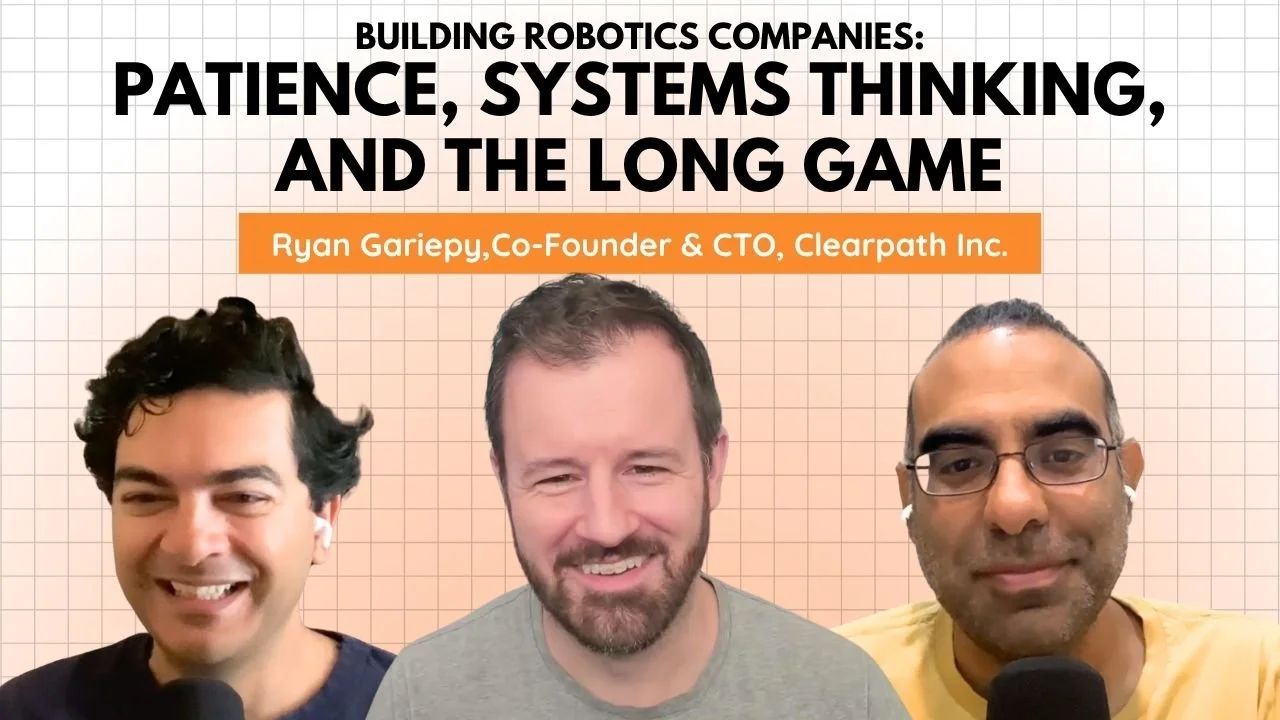
Ryan Gariepy explains why robotics is slow, why humanoids are overhyped, and what founders get wrong about building hardware companies.
In this episode of the Founders in Arms podcast, we sit down with Ryan Gariepy, co-founder of Clearpath Robotics and Otto Motors, to talk about robotics, hardware startups, and why building in the physical world takes decades—not years.
Ryan explains why robotics is fundamentally a systems problem, why hype cycles keep repeating, and why many founders misunderstand what it takes to succeed in hardware.
The conversation also explores humanoid robots, venture capital dynamics in robotics, and why the most successful companies start with narrow, practical use cases.
This conversation dives deep into:
Robotics as a systems discipline
Why hardware compounds over decades
Bootstrapping when “nobody cared about robotics”
Why humanoid robots are overhyped
The role of venture capital in shaping bad incentives
Why robotics companies should start narrow
How talent dynamics differ in hardware vs software
The future of physical AI and real-world automation
In this episode, we cover:
(00:00) Robotics is a systems problem, not a single breakthrough
Ryan explains that robotics is not unlocked by one technology like AI or better sensors.
Instead, progress comes from many layers of technology compounding over time—hardware, software, manufacturing, and systems integration.
He compares it to semiconductor manufacturing, where no single company or invention created modern chips.
(06:30) Building a robotics company when nobody believed in it
In the early days, robotics was not seen as a viable business.
Ryan explains that from 2009 to 2014, Clearpath struggled to raise capital and had to bootstrap.
At the time, most people believed robotics could only work in defense, not commercial markets.
(08:18) Becoming profitable in 18 months
Despite limited funding, Clearpath became profitable quickly by focusing on real customers.
Their early customers were:
Universities
Research labs
Government institutions
This forced them to build practical products instead of speculative technology.
(10:28) Starting with a platform, not a full solution
Clearpath began by building robotics platforms for researchers.
They provided modular systems that allowed customers to experiment and build their own applications.
Only later did they expand into industrial automation, where the larger opportunity emerged.
(18:16) Why robotics is more exciting now than ever
Ryan argues that today is the most exciting time in robotics history.
This is driven by:
Better underlying technology
More available capital
Greater societal adoption
However, he warns that excitement often leads to unrealistic expectations.
(19:22) Why hype cycles keep repeating in robotics
Each generation believes a new technology will “solve” robotics.
Previously it was:
Deep learning
Convolutional neural networks
More data
Today it is LLMs and transformers.
Ryan argues that none of these are silver bullets—progress remains incremental and system-driven.
(22:17) Hardware vs software growth dynamics
Ryan contrasts software and robotics growth.
Software:
Fast growth
Quick scaling
Rapid saturation
Robotics:
Slower growth
Sustained over decades
Compounding impact
He warns founders not to expect software-like growth in hardware businesses.
(23:40) Why build a robotics company at all?
Despite the difficulty, Ryan says founders should build in robotics because:
It is fun
The problems matter
It creates real-world impact
He emphasizes that Clearpath was not started because it was financially optimal.
(25:27) Hardware attracts mission-driven talent
Ryan explains that hardware companies often attract people who genuinely love building physical systems.
This creates a unique advantage:
Stronger long-term commitment
Passion-driven teams
Lower sensitivity to short-term outcomes
(27:20) Physical AI and real-world impact
Ryan argues that software alone cannot solve many real-world problems.
At some point, physical systems are required:
Autonomous logistics
Manufacturing
Infrastructure
This is where robotics becomes essential.
(28:13) Humanoid robots: impressive but miscalibrated
Ryan believes humanoid robots are technologically impressive but overhyped.
The challenges include:
High cost
Complex deployment
Unsolved general intelligence
He also introduces the idea that robot form factors create expectations for users.
(32:41) The “promise problem” in robotics
A key insight:
The more a robot looks like a human, the more users expect from it.
A Roomba sets a narrow expectation (cleaning floors).
A humanoid suggests it can do everything.
When expectations are not met, adoption suffers.
(34:35) Why consumer robotics is still early
Even advanced consumer robots still face trust issues.
Users often:
Don’t fully trust them to complete tasks
Need supervision
Prefer manual control
This slows adoption despite technological progress.
(36:01) Why vertical robotics wins
Ryan points out that the most successful robots today are highly specialized.
Examples include:
Restaurant delivery robots
Airport cleaning robots
Warehouse automation
These succeed because they operate in controlled environments.
(41:15) Venture capital can distort robotics companies
Ryan explains that large venture funds often push companies toward unrealistic strategies.
Large check sizes force:
Bigger visions
Faster scaling
Riskier bets
Smaller, more patient capital allows companies to focus on practical progress.
(45:22) Why robotics is less competitive than software
Unlike software, robotics has:
Higher barriers to entry
Longer development cycles
Fewer competitors
This can make it attractive for investors despite slower growth.
(50:31) Biggest mistake: ignoring gut instinct
Ryan shares that one of his biggest mistakes was trusting a charismatic but inexperienced executive over his own instincts.
The result was a product decision that created long-term issues.
His takeaway:
Trust your instincts as a founder.
Key Takeaways for Founders
Robotics is a systems problem
There is no single breakthrough that unlocks robotics. Progress comes from multiple technologies compounding over time.
Hardware requires different expectations
Founders should not expect software-like growth. Robotics companies scale more slowly but can build enduring advantages.
Start narrow, then expand
The most successful robotics companies begin with specific use cases and expand over time.
Hype cycles are inevitable
Every generation believes a new technology will solve robotics. Founders should stay grounded in reality.
Form factor shapes user expectations
What your product looks like determines what users expect it to do.
Trust your instincts
Founders often have better judgment than they give themselves credit for—especially early on.
About the Guest
About Ryan Gariepy
Ryan Gariepy is the co-founder of Clearpath Robotics and Otto Motors, companies focused on autonomous mobile robots for industrial applications.
He spent over a decade building one of the leading robotics companies in North America before its acquisition by Rockwell Automation.
Listen to Founders in Arms
Founders in Arms is a podcast for ambitious builders—covering startups, AI, robotics, leadership, and the realities of building enduring companies.
🎙 Subscribe to Founders in Arms on your favorite platform
💬 Join the conversation at TribeChat.com
🚀 Discover more insights from founders and operators shaping the future of technology
