
Prospero AI Founder on Beating the Market, ETFs vs Stock Picking, and the Power of Data
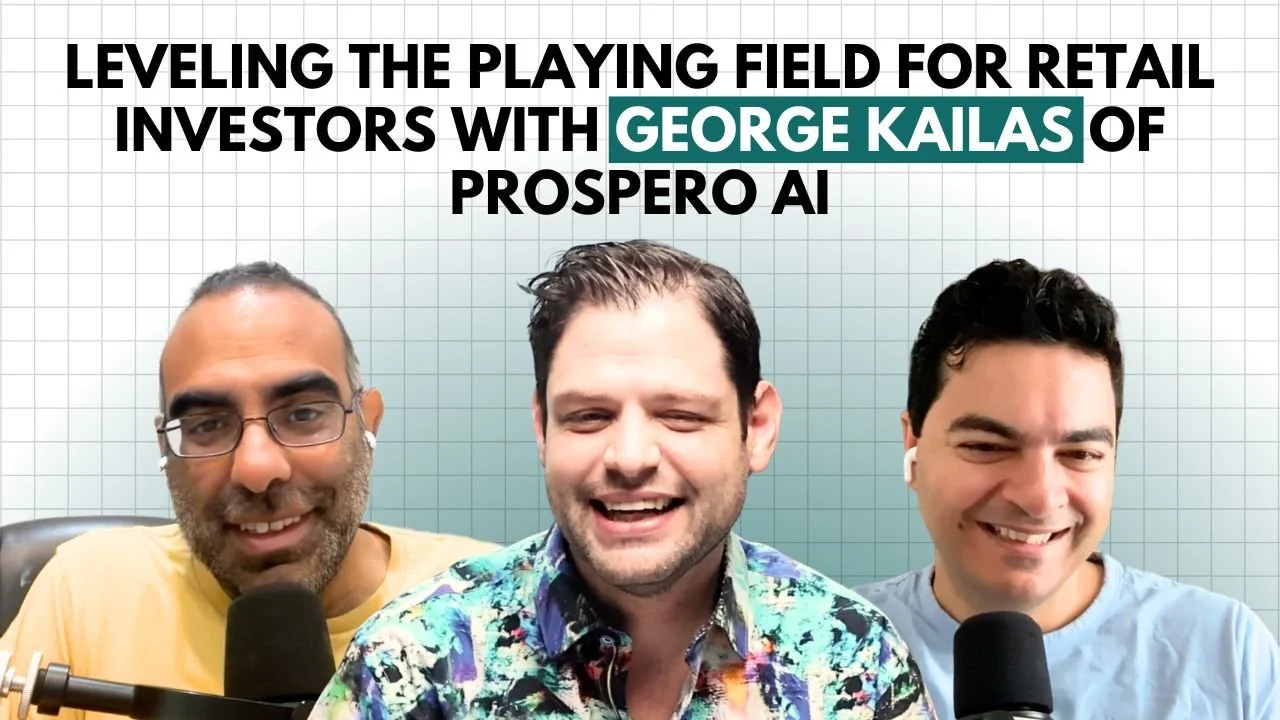
Prospero AI founder George Kailas joins Founders in Arms to break down one of the biggest debates in investing: should you pick stocks—or just buy ETFs?
In this episode, George shares how retail investors are increasingly driving markets, why most people shouldn’t be picking stocks, and how data—not software—is becoming the true edge in investing.
The conversation also explores the rise of AI in finance, the ethics of trading platforms, and why learning to exit positions is the hardest (and most important) skill in investing.
This conversation dives deep into:
ETFs vs stock picking
The “1-hour rule” for investors
Retail vs institutional market dynamics
AI and data as the future of investing
Why most analyst ratings are unreliable
How Prospero’s signal system works
The hidden costs of “free” trading apps
Risk, crypto, and retail behavior
Crowdfunding as a growth strategy
In this episode, we cover:
(00:00) ETFs vs stock picking: the real answer
George says both approaches can work—but it depends on your time commitment.
If you don’t have time to learn, stock picking is a losing game.
(07:42) The “1-hour rule” for investing
A simple framework:
<1 hour/week → buy ETFs
More time → you can learn stock picking
“If you have less than an hour a week, buy and hold all day long. ETFs easiest.”
(08:00) Retail investors are now driving markets
A major shift:
Retail makes up ~35% of the market
Algorithms often follow retail behavior
This flips the traditional belief that institutions lead markets.
(10:30) Why exiting trades is the hardest skill
Making money isn’t just about picking the right stock.
The real challenge:
Knowing when to sell
Managing risk
Avoiding emotional decisions
Most investors fail on exits—not entries.
(11:30) Why analyst ratings can’t be trusted
George and the hosts discuss a harsh reality:
Analyst ratings are often biased
Investment banks have conflicting incentives
Ratings can be influenced by business relationships
This has eroded trust in traditional research.
(13:00) How Prospero AI beats the market
Prospero uses a system of 10 signals to simplify investing:
Profitability
Growth
Options sentiment
Social sentiment
Dark pool activity
Over 4 years, their picks have reportedly beaten the market by ~65%.
(15:00) Simplifying complex data for retail investors
Instead of overwhelming users:
All signals are scaled 0–100
Data is normalized for easy comparison
Users can quickly understand risk and opportunity
The goal: make institutional-level data usable.
(17:30) The hidden cost of “free” trading apps
Platforms like Robinhood aren’t truly free.
How they make money:
Payment for order flow
Selling order data to institutions
Allowing institutions to profit from retail trades
Retail investors may unknowingly lose value on execution.
(19:30) Why retail investors lose power
When trades are routed through brokers:
Orders are bundled
Sent to dark pools
Executed in ways that benefit institutions
Retail influence gets diluted in the process.
(21:30) Why data—not software—is the real moat
George’s core thesis:
Software is becoming commoditized
AI reduces the value of pure technology
Data is the real differentiator
“The value of technology is going to zero… the value of data goes through the roof.”
(23:00) The future: intent data
Prospero’s long-term vision:
Collect user “intent data”
Predict behavior before transactions happen
Build a more accurate market model
Example:
What people plan to buy
Spending expectations
Consumer sentiment
(26:00) The rise of crypto traders
A growing trend:
Young people skipping traditional jobs
Trading crypto full-time
Treating markets as income
This creates both opportunity—and risk.
(27:00) Why some investors need to lose first
A controversial but honest take:
Some people only learn through losses.
Risk appetite is cultural
Experience shapes discipline
Losses often lead to better behavior
(29:00) Why AI tools struggle with investing
AI can pick stocks—but struggles with:
Risk management
Market volatility
Timing exits
This limits their real-world performance.
(31:00) Why simplicity wins for most investors
The host shares Mercury’s strategy:
Stick to ETFs
Avoid overthinking
Focus on long-term allocation
For most people, this is the best approach.
(31:30) Why Prospero chose crowdfunding
Instead of traditional VC:
Raised ~$500K via crowdfunding
Built stronger community alignment
Created early product evangelists
(33:00) The surprising impact of community
Crowdfunding revealed:
Many users deeply valued the product
Strong emotional connection
Real-world impact beyond metrics
Key Takeaways for Founders
Most people shouldn’t pick stocks
If you don’t have time, stick to ETFs.
Retail investors are more powerful than ever
But still disadvantaged by infrastructure.
Data is becoming the real competitive edge
Software alone is no longer enough.
“Free” products often have hidden costs
Understand how platforms make money.
Risk management matters more than stock picking
Exiting positions is the hardest skill.
AI is powerful—but not complete
Especially weak at handling uncertainty and risk.
Great products simplify complexity
Turning data into usable insights is key.
About the Guest
George Kailas is the founder and CEO of Prospero AI, a platform focused on helping retail investors make better decisions through data-driven insights.
He has spent over a decade working in AI, financial modeling, and alternative data, with experience building systems used by hedge funds and institutions.
Listen to Founders in Arms
Founders in Arms explores the ideas shaping technology, startups, and the future of innovation.
🎙 Subscribe to Founders in Arms on your favorite platform.
💬 Join the conversation at TribeChat.com and chat directly with Rajat Suri, Immad Akhund, and guests.
🚀 Discover more insights from founders and operators shaping the future of technology.
