
Outcast Ventures: Why Strangers Make Better Co-Founders
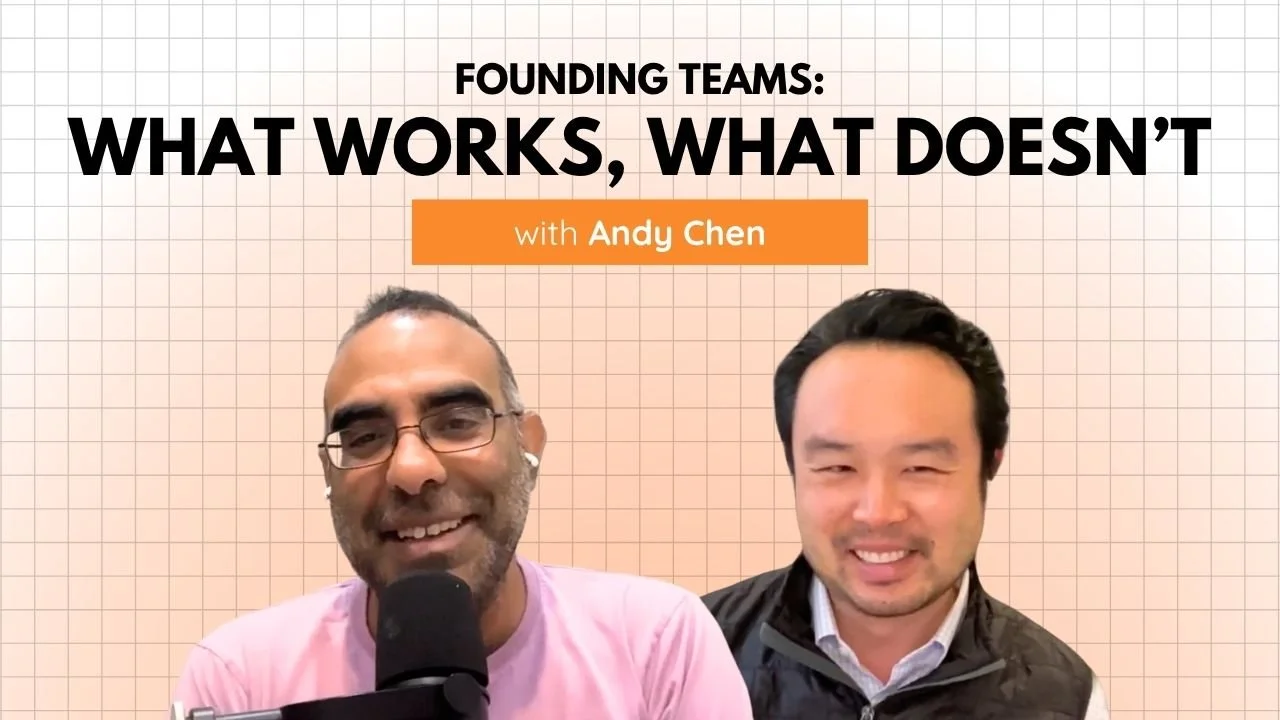
Outcast Ventures co-founder Andy Chen joins Founders in Arms to challenge one of the most common startup assumptions: that the best co-founders are people you already know.
Drawing on deep research across decades of billion-dollar companies, Andy explains why that intuition is often wrong—and how the future of company building may start with rethinking how founding teams are formed.
This episode dives into venture capital, founder psychology, and why the “atomic unit” of startups—the founding team—is due for reinvention.
This conversation dives deep into:
Why successful founders struggle to find co-founders
Research on billion-dollar founding teams
Why strangers outperform friends as co-founders
How venture capital has evolved
Talent vs. ideas in startup success
The rise of solo founders (and their limits)
AI’s impact on company formation
Consumer vs. enterprise trends
A new model for building companies
In this episode, we cover:
(00:00) Why successful founders struggle to find co-founders
Ironically, success can make it harder to start again.
Why?
Networks become filled with CEOs and investors
Builders (engineers/operators) are missing
Former collaborators are no longer available
Your network narrows as you succeed.
(03:30) Andy’s unconventional path into venture
Andy’s journey wasn’t typical:
Engineer → recruiter → CIA → venture capital
Early exposure to Silicon Valley at a critical moment
Deep experience in talent and hiring
This shaped his unique perspective: startups are fundamentally about people.
(05:30) The core question: what makes great founding teams?
Andy analyzed:
Every tech IPO in the last 20 years
Billion-dollar acquisitions
Founder relationships and backgrounds
The goal: understand what actually drives success.
(06:30) The surprising insight: strangers perform better
One of the most counterintuitive findings:
Founders who did NOT work together before often build more valuable companies.
Why?
Less overlap in skills
Broader networks
More complementary strengths
(07:30) The hidden problem with networks
Most founders recruit from their existing network.
But:
Networks are biased toward similarity
Skills often overlap
Diversity of thinking is limited
This reduces the ceiling of the company.
(08:30) What actually makes a great co-founder match
It’s not just about knowing someone.
It requires alignment across:
Skills
Interests
Timing
Life stage
All four must align—rare in practice.
(09:30) The Outcast Ventures model
Outcast is rethinking how companies are formed.
Instead of:
Random networking
Warm intros
Existing relationships
They:
Bring together 60–80 founders
Align them on timing and intent
Facilitate structured co-founder matching
(11:00) Why existing platforms don’t work
Traditional approaches (like open matching platforms):
Too broad
Poorly curated
Lack precision
Finding a co-founder requires high signal—not scale.
(12:00) The rise of the “AI generation” of founders
A new trend:
Founders born in the 90s/2000s
Building AI-native companies
Creating larger companies faster than previous generations
This may be the biggest startup wave yet.
(13:00) Why the team matters more than the idea
Andy’s investing philosophy:
Start with the team
Work backward to the idea
Because:
Ideas change
Teams persist
“The idea almost doesn’t matter—what matters is the team.”
(14:30) Why venture is still a network-driven industry
Despite being talent-driven:
Venture is hard to break into
Networks perpetuate themselves
Most investors come from finance backgrounds
Talent-focused investors are still rare.
(17:30) Why Outcast is a generalist fund
Rather than focusing on sectors:
Focus on exceptional people
Follow talent into emerging trends
Stay flexible across decades
This mirrors firms like Sequoia and Kleiner Perkins.
(20:00) Consumer vs. enterprise in the AI era
Current trend:
Most startups are enterprise-focused
Faster monetization
Easier fundraising
But:
Consumer innovation is still emerging
New AI-native ideas are forming
Opportunity remains wide open
(24:30) The rise (and limits) of solo founders
AI has enabled more solo founders than ever.
But:
They rarely build generational companies
Top outcomes almost always require teams
Solo founders succeed—but teams win at scale.
(27:30) The evolution of venture capital
Venture has evolved through generations:
Early firms (Sequoia, Kleiner)
Equal partnership models (Benchmark)
Platform + services (Andreessen Horowitz)
Data-driven investing (Coatue)
Now:
The next evolution may focus on how companies are formed.
(29:30) The “atomic unit” of startups
The key insight:
The founding team is the most important—and least optimized—part of startups.
Outcast’s bet:
If you improve how teams are formed, you improve outcomes.
(31:00) The most valuable feedback Andy received
A pivotal lesson:
“You’re being too defensive.”
Impact:
Learned to listen better
Communicate more effectively
Stay open under pressure
(33:00) The most rewarding part of venture
It’s not returns.
It’s people.
Meeting ambitious founders
Watching them take risks
Seeing ideas become reality
(34:00) A detour: working at the CIA
Before venture, Andy worked as a weapons analyst.
Experience included:
High-stakes decision-making
National security work
Extreme discipline and rigor
(37:00) Advice for young people
Andy’s perspective:
Work in government
Travel the world
Build something
Exposure creates opportunity.
Key Takeaways for Founders
Your network may limit your potential
Looking outside it can unlock better outcomes.
Strangers can make better co-founders
Complementarity beats familiarity.
The team matters more than the idea
Ideas evolve—teams execute.
Solo founders are rising—but teams still win
Big outcomes require collaboration.
Timing, skills, and alignment all matter
Co-founder fit is multi-dimensional.
We’re in a new era of company formation
AI is changing how startups are built—and who builds them.
About the Guest
Andy Chen is the co-founder of Outcast Ventures, an early-stage venture firm focused on rethinking how founding teams are formed.
He previously worked at Coatue, Kleiner Perkins, and in talent roles across Silicon Valley, bringing a unique perspective on the importance of people in startup success.
Listen to Founders in Arms
Founders in Arms explores the ideas shaping technology, startups, and the future of innovation.
🎙 Subscribe to Founders in Arms on your favorite platform.
💬 Join the conversation at TribeChat.com and chat directly with Rajat Suri, Immad Akhund, and guests.
🚀 Discover more insights from founders and operators shaping the future of technology.
