
Airwallex Founder on Global Banking, Competition, and Building Through Controversy
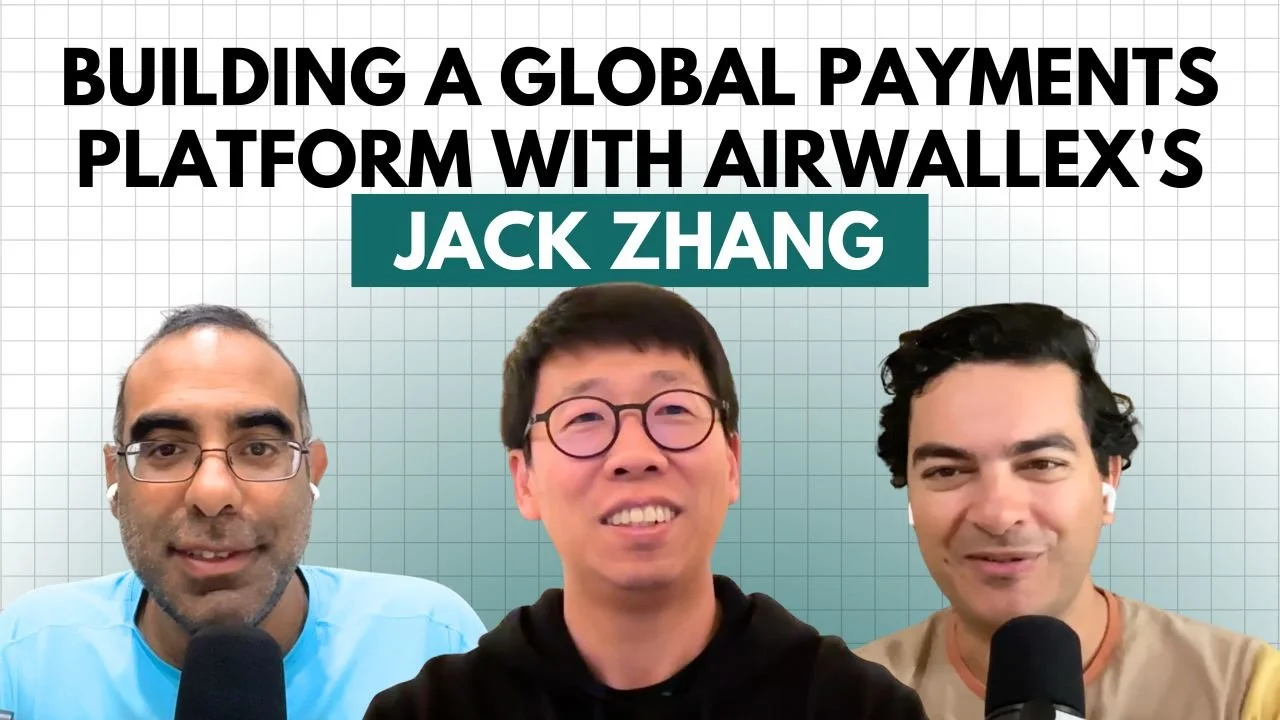
Airwallex founder Jack Zhang joins Founders in Arms to share how he built an $8B global fintech company—from a coffee shop problem to processing hundreds of billions in payments.
In this episode, Jack breaks down the realities of building a global financial infrastructure company, competing with incumbents like HSBC and Stripe, and navigating geopolitical tension, public attacks, and high-stakes competition.
This is a deep dive into what it really takes to build a global company from day one.
This conversation dives deep into:
The founding story of Airwallex
Cross-border payments and global banking
Building fintech infrastructure at scale
Competing with Stripe, banks, and global players
FUD (fear, uncertainty, doubt) in startups
Hiring and scaling globally
Founder mindset and resilience
Turning controversy into advantage
Why founders keep going (even when they don’t have to)
In this episode, we cover:
(00:00) The vision: building a global financial system
Airwallex is building:
A real-time
Borderless
Intelligent financial operating system
Designed to help businesses operate globally without friction.
(02:30) The origin: a coffee business problem
The idea came from Jack’s own business.
Pain points:
Slow international payments
High fees ($30–$50 per transfer)
FX costs of 4–5%
That inefficiency became the opportunity.
(05:00) A lifelong builder
Jack started his first business at 14.
That early success created:
A “taste” for building
A constant drive to experiment
A search for something meaningful to go all-in on
(07:00) Scaling to a global platform
Today, Airwallex:
Processes ~$300B in transactions
Operates in 120+ countries
Has ~2,000 employees
Generates ~$1B+ in revenue
Yet still has <1% market share.
(08:30) Competing with global banks
The ambition isn’t just fintech—it’s bigger.
Airwallex is competing with:
Traditional banks (HSBC, Citi)
Payment platforms
Global financial infrastructure
The goal: become a new type of global bank.
(10:00) Why global-first matters
Outside the U.S., companies go global early.
That creates demand for:
Multi-currency support
Cross-border payments
Financial infrastructure from day one
(12:00) The rise of global businesses
A major shift:
U.S. companies now generate ~40–50% of revenue internationally
This was <20% decades ago
Globalization is no longer optional—it’s default.
(14:30) The controversy: accusations and public attacks
Airwallex faced public accusations about data security and origins.
Jack’s view:
Claims were fabricated
No evidence supported them
Driven by competitive narratives
(16:30) How founders should think about competition
Jack’s philosophy:
Compete with product, not narratives
Build long-term brand trust
Focus on customers, not noise
“We always believe the best product wins.”
(18:00) FUD in startups (fear, uncertainty, doubt)
This is more common than founders expect.
Tactics include:
Spreading doubt
Attacking credibility
Influencing perception
Especially in regulated industries like fintech.
(20:00) Turning controversy into advantage
Unexpected upside:
Increased awareness
Stronger brand recognition
More customer interest
Even negative attention can drive growth.
(26:30) Hiring mistakes early on
One of the biggest lessons:
Hiring the wrong people early is extremely costly.
Common issues:
Misaligned incentives
Territorial behavior
Prioritizing self over company
(27:30) Why hiring never stops being important
Even at 2,000 employees:
Hiring is still a top priority
Founders must stay involved
Talent quality compounds over time
(28:00) The challenge of global teams
Running a global company is harder than expected:
Multiple time zones
Distributed leadership
Constant trade-offs
Finding executives willing to operate globally is especially difficult.
(31:00) Mission alignment matters more than geography
The best hires aren’t defined by location.
They’re defined by:
Belief in the mission
Connection to the founder
Willingness to endure complexity
(33:00) Why AI valuations may not last
Jack’s take:
Current AI valuations may be inflated
Eventually normalize to public market multiples
Growth alone doesn’t justify pricing forever
(35:00) Turning down Stripe’s acquisition
Airwallex rejected an early acquisition by Stripe.
Why?
Belief in long-term potential
Unique market opportunity
Desire to build something enduring
(36:30) The real reason founders don’t sell
It’s not about money.
It’s about:
Impact
Opportunity
Fear of missing out on building something great
(38:00) Founder psychology: chasing difficulty
Founders aren’t normal.
They:
Seek hard problems
Endure constant pressure
Find meaning in solving challenges
(40:00) The hardest part of building
Not technical.
Not operational.
It’s dealing with:
Perception vs. truth
Public narratives
Situations outside your control
Key Takeaways for Founders
Global is the default future
Build for international from day one.
The best product still wins (long-term)
But short-term narratives can matter.
FUD is part of competition
Especially in high-stakes markets.
Hiring is your most important job—forever
Early mistakes compound massively.
Global companies are exponentially harder to run
Time zones and coordination are real challenges.
Not selling is often irrational—but meaningful
Great founders optimize for impact, not money.
Resilience is a core founder skill
You will face things outside your control.
About the Guest
Jack Zhang is the co-founder and CEO of Airwallex, a global fintech company building a modern financial operating system for businesses.
Founded in 2015, Airwallex has grown into an $8B company operating across 120+ countries, helping businesses move and manage money globally.
Listen to Founders in Arms
Founders in Arms explores the ideas shaping technology, startups, and the future of innovation.
🎙 Subscribe to Founders in Arms on your favorite platform.
💬 Join the conversation at TribeChat.com and chat directly with Rajat Suri, Immad Akhund, and guests.
🚀 Discover more insights from founders and operators shaping the future of technology.
