
Weebly Founder on Cash Flow, Surviving Near Death, and Why Profitability Wins
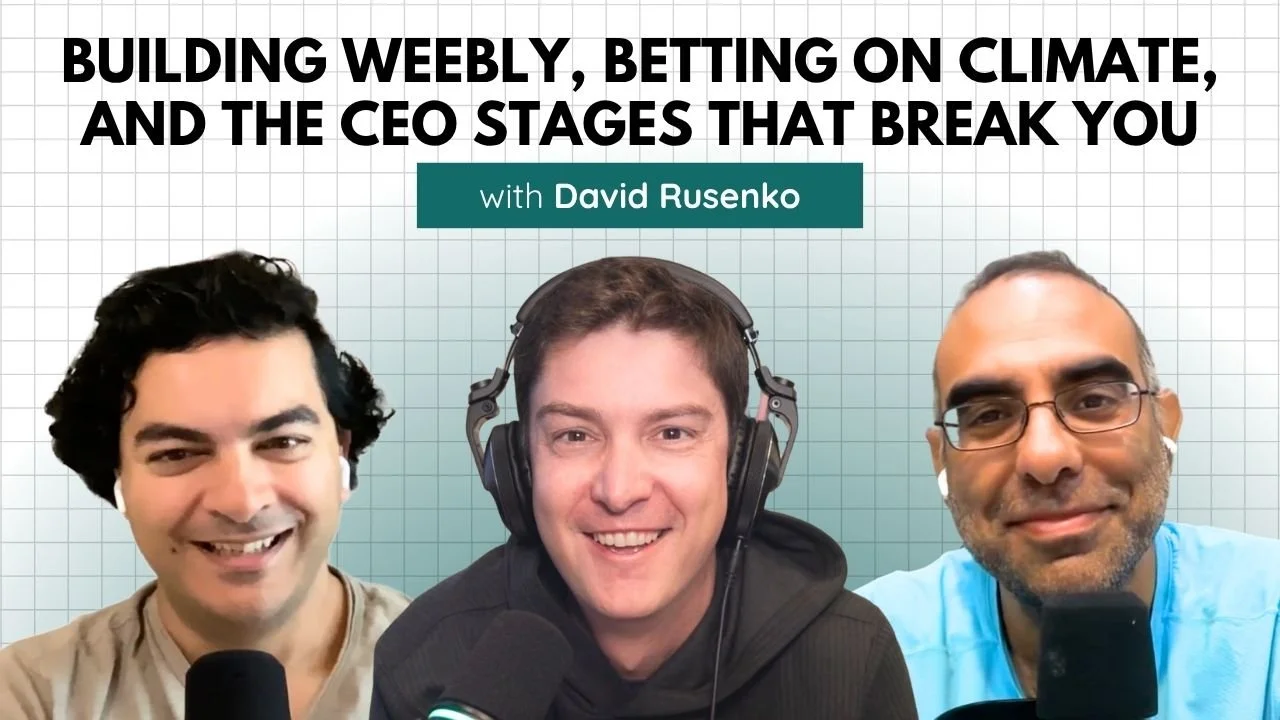
Weebly founder David Rusenko joins Founders in Arms to share the full story behind building a $365M company—from near-bankruptcy moments to becoming cash flow positive and controlling their own destiny.
In this episode, David breaks down why most founders misunderstand dilution, how cash flow can be your biggest strategic advantage, and what actually changes as your company scales from 10 to 200+ people.
This is a masterclass in building sustainably—and surviving long enough to win.
This conversation dives deep into:
Weebly’s near-death startup moments
The importance of cash flow vs. fundraising
Why dilution actually happens
Bootstrapping vs. venture capital
How to reach profitability early
Scaling challenges at 25, 75, and 175 employees
Building company culture intentionally
Climate tech investing and cycles
Word-of-mouth growth strategies
Founder lessons from a 14-year journey
In this episode, we cover:
(00:00) The truth about dilution
Most founders think dilution happens when you raise money.
David argues the opposite:
You get diluted when you spend money inefficiently—not when you raise it.
(00:30) Why cash flow gives you control
Being cash flow positive changes everything:
You don’t need to accept bad terms
You can walk away from investors
You control your company’s destiny
This leverage is rare—and powerful.
(01:00) The overlooked lever: timing of cash
Many founders ignore a key insight:
Cash timing matters more than revenue.
Examples:
SaaS annual plans improve cash flow
Upfront payments create a flywheel
Even hardware companies can benefit
(03:00) From founder to investor
After 14 years building Weebly, David chose investing over starting another company.
Why?
Wanted to “pay it forward”
Help founders avoid mistakes
Think long-term across many companies
(05:00) Why climate tech comes in waves
Climate investing isn’t linear—it cycles.
Drivers include:
Politics
Oil prices
Technology readiness
But long-term trends (like solar cost declines) continue improving regardless.
(08:30) The timing problem in deep tech
Many startups fail not because they’re wrong—but because they’re early.
Like the dot-com bubble:
Vision was correct
Timing was off by 10–20 years
(10:30) Nuclear vs. renewables
David believes:
Nuclear is promising—but slow
Renewables are improving rapidly
Oil will remain part of the mix for decades
Energy transition will require all sources.
(12:30) Why David chose investing over building
After a long founder journey, he wanted to:
Help others succeed
Leverage experience across startups
Shift from operator → coach
(14:00) No regrets selling Weebly
Despite future upside, David stands by the acquisition.
Why?
Right timing
Right partner (Square)
Personal readiness to move on
(15:00) The real problem with website builders
People don’t want websites.
They want:
Customers
Growth
Revenue
The website is just a tool.
(17:30) Scaling challenges as CEO
At ~25 employees
Flat org breaks
Need first management layer
Delegation becomes critical
At ~75 employees
Communication distorts
People “manage up”
Feedback becomes less honest
Example: suddenly, all your jokes become funny.
At ~175 employees
Functional org breaks
Need cross-functional teams
Company structure must evolve
(23:00) Designing culture intentionally
Culture doesn’t happen by accident.
You must:
Reinforce desired behaviors
Remove bad incentives
Document values as you scale
(28:00) How to eliminate internal politics
Key principle:
Force direct communication.
Instead of escalating issues:
Talk to the person directly
Resolve peer-to-peer
Only escalate if necessary
This strengthens teams and reduces politics.
(32:30) Weebly’s near-death moments
2006–2007
Less than 30 days of cash
Couldn’t pay rent
Survived through demo day
2008 financial crisis
Fundraising failed
Investors offered bad terms
Team slashed costs and survived
(34:30) The turning point: monetization
Initially, no one paid.
Then:
Better understanding of active users
Improved pricing strategy
Gradual monetization success
(35:30) The big realization: vanity metrics
Weebly overestimated growth by focusing on:
Signups instead of active users
Reality:
Only a fraction were engaged
(36:30) From near death to profitability
After nearly running out of money:
Weebly became cash flow positive
Stayed profitable over its lifetime
Ended with more cash than total capital raised
(37:30) Bootstrapping vs. VC
Key insight:
Growth is most important
But money should only be raised with clear ROI
Otherwise:
You’re just increasing burn and risk.
(38:00) The best framing of fundraising
Raising money isn’t dilution.
Spending it poorly is.
(40:00) How Weebly grew: word of mouth
~80% of growth came from:
Organic referrals
Product quality
User satisfaction
(41:00) The secret: build a 10x product
Weebly achieved:
~80% Net Promoter Score
That level of product love drives:
Word of mouth
Sustainable growth
Long-term success
Key Takeaways for Founders
Cash flow is power
Profitability gives you leverage in every decision.
Dilution comes from bad spending, not fundraising
Be intentional with how you deploy capital.
Timing matters more than vision
Being early can look like being wrong.
Every stage of scaling requires a new CEO
Your role must evolve as the company grows.
Culture must be designed, not assumed
Left unchecked, it will drift.
Word of mouth is the strongest growth channel
But only if your product is truly great.
Vanity metrics can kill you
Focus on real usage, not signups.
About the Guest
David Rusenko is the founder and former CEO of Weebly, a website builder used by millions of small businesses and acquired by Square for $365M.
He is now the founder of Leap Forward Ventures, investing in early-stage climate and deep tech startups.
Listen to Founders in Arms
Founders in Arms explores the ideas shaping technology, startups, and the future of innovation.
🎙 Subscribe to Founders in Arms on your favorite platform.
💬 Join the conversation at TribeChat.com.
🚀 Discover more insights from founders and operators shaping the future of technology.
