
Venmo Founder on Near Shutdown, Product Virality, and Building Consumer Magic
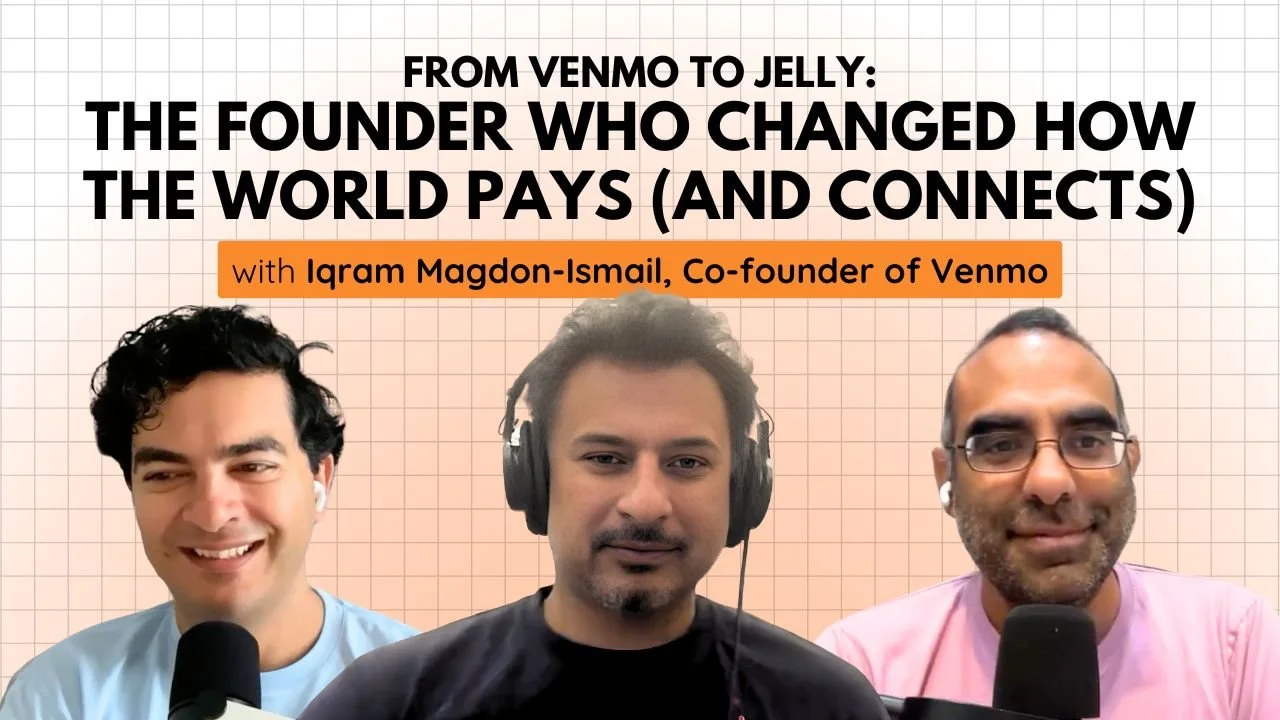
Venmo co-founder Ikram Magden Ismail joins Founders in Arms to share the chaotic early days of building one of the most iconic consumer fintech products—and how close it came to dying.
From hacking together payments over SMS to nearly getting shut down by Wells Fargo, this episode dives into the real story behind Venmo’s growth, survival, and eventual acquisition.
Ikram also shares what made Venmo feel different from every other payments app—and why modern startups may have lost that magic.
This conversation dives deep into:
The origin story of Venmo
Early startup scrappiness and naïveté
Building payments on hacked infrastructure
The near-death moment with Wells Fargo
Why giving away money was the best marketing
Braintree acquisition and survival
What made Venmo feel “different”
Consumer vs. B2B startups
Why modern startups lack personality
Building new social products (Jelly)
In this episode, we cover:
(00:00) The moment Venmo almost died
At one point, Venmo had days left before being shut down.
If Wells Fargo pulled support, the company would collapse entirely.
(04:30) The origin story: forgetting a wallet
Venmo started with a simple problem:
Splitting a dinner bill when one founder forgot his wallet.
That sparked the idea for instant peer-to-peer payments.
(06:00) Why they started (without a grand plan)
There was no master strategy.
It began as:
A side project between friends
A way to build something together
A game that got more interesting over time
Momentum—not planning—drove the company forward.
(08:20) The first version: payments over SMS
Before apps, Venmo worked via text message.
They hacked together a system using:
Google Voice APIs
Credit card processing
Phone numbers as identity
(09:00) The “rookie mistake” that fueled growth
Venmo covered all credit card fees.
Meaning:
Sending money was free
The company lost money on every transaction
But this became their best growth strategy.
(10:30) The first real challenge: becoming legitimate
Early infrastructure wasn’t sustainable.
They had to:
Transition from hacks to real payment systems
Navigate money transmission laws
Build compliance (AML, banking relationships)
(11:30) The power of the right investors
Investors didn’t just provide capital—they unlocked access.
Introductions helped Venmo:
Avoid shutdown
Build banking relationships
Scale legally
(14:30) The second crisis: running out of money
Venmo’s growth created a paradox:
More usage → higher costs
More transactions → more losses
They burned through funding quickly due to fees.
(15:30) The Wells Fargo shutdown threat
Wells Fargo warned they would shut Venmo down due to risk exposure.
The team had to tell employees the company might die within days.
(16:30) The Braintree acquisition that saved Venmo
A last-minute deal with Braintree changed everything.
It allowed Venmo to:
Transition to ACH (lower costs)
Gain infrastructure
Survive long enough to scale
(17:30) Why the acquisition was actually a win
Despite Venmo’s later success, Ikram has no regrets.
The partnership provided:
Stability
Scale
A path to long-term survival
(19:00) What made Venmo feel different
Venmo wasn’t just functional—it had personality.
Examples:
Public-by-default social feed
Playful product decisions
Cultural relevance
It felt like a social product, not just fintech.
(21:00) Why modern startups feel “soulless”
Ikram argues many startups today focus too much on:
ARR
Fundraising
Metrics
And not enough on:
Purpose
Personality
User emotion
(23:00) Startup culture has changed
AI and tools make it easier than ever to look polished.
But that comes at a cost:
Less authenticity
Less creativity
Less product soul
(27:00) Consumer vs. B2B startups
Ikram believes consumer is harder—but more powerful.
Why?
Harder distribution
Harder monetization
But deeper impact
If you win consumer, you can expand into anything.
(30:00) Social media is broken
Modern platforms are dominated by:
Ads
Influencers
Status signaling
Instead of genuine connection.
(31:00) The vision behind Jelly
Ikram’s new startup aims to fix that.
Core ideas:
Short-form, real conversations
No filters or heavy editing
Built for authentic interaction
(38:00) Crypto + social = new payments layer
Jelly integrates:
Memecoins
Stablecoins
Global transactions
Enabling instant, borderless payments inside social interactions.
(40:00) Why invite-only still works
Jelly is growing slowly and intentionally.
Benefits:
Higher-quality users
Stronger community
Better feedback loops
(42:00) Lessons on hiring and leadership
One major regret:
Letting people go too quickly.
In hindsight, Ikram believes:
Patience matters
Teams need time to grow
Culture is fragile
(45:00) The immigrant founder mindset
Ikram credits his background for his drive:
Constant adaptation
Strong work ethic
Desire to prove yourself
This mindset often fuels great founders.
Key Takeaways for Founders
Start simple—momentum matters more than planning
Great companies often begin as side projects.
Naïveté can be an advantage
Not knowing the challenges helps you start.
Growth can kill you if your model is broken
More users isn’t always better if costs scale faster.
Infrastructure dependencies are existential risks
Losing a key partner can shut down your business overnight.
Personality is a competitive advantage
Products that make people feel something win.
Consumer products are harder—but more powerful
Winning users emotionally creates massive upside.
Modern startups may be too optimized
Polish doesn’t replace authenticity.
About the Guest
Ikram Magden Ismail is a co-founder of Venmo, one of the most widely used peer-to-peer payments platforms in the U.S.
After Venmo’s acquisition by Braintree (and later PayPal), he went on to build multiple startups and is now working on Jelly, a new social platform combining video and payments.
Listen to Founders in Arms
Founders in Arms explores the ideas shaping technology, startups, and the future of innovation.
🎙 Subscribe to Founders in Arms on your favorite platform.
💬 Join the conversation at TribeChat.com.
🚀 Discover more insights from founders and operators shaping the future of technology.
